
New Delhi, Nov 12 (IANS) For years, farmers in Punjab, Haryana, and western Uttar Pradesh have found themselves at the centre of Delhi-NCR’s annual pollution debate – especially if one of these states were ruled by a different political party – over the issue of burning crop stubble between agricultural cycles.
Farmer organisations have repeatedly argued that while stubble burning contributes to seasonal pollution, it has been unfairly portrayed as the principal culprit.
Now, there is a cautious sigh of relief among the farmers of the region as the onus shifts to traffic emissions, with a prominent union leader calling for “family planning of cars”.
Welcoming the Supreme Court’s intervention this week, Bharatiya Kisan Sangh (BKS) General Secretary Mohini Mohan Mishra asked states to withdraw such cases against farmers and return any fines imposed on them with interest.
“The strong objection raised by the Supreme Court against blaming only farmers for pollution makes it clear that farmers are not the primary cause of pollution,” the Rashtriya Swayamsevak Sangh (RSS)-affiliated farmer organisation leader said.
“The administration should pay attention to pollution from vehicles. There should be ‘family planning’ for cars with respect to the numbers owned by a family,” he emphasised.
The All India Kisan Sabha (AIKS), the peasant wing of the Communist Party of India (CPI), meanwhile, blamed government policies penalising the farming community.
“Agriculture has been painted as a polluting job, while legislations are framed to support corporates,” AIKS President Rajan Kshirsagar alleged.
“We’ve been repeatedly stressing that stubble burning is not the principal reason for pollution in Delhi and the NCR, as it is evident,” he added.
The Supreme Court’s observation, while hearing on Delhi-NCR’s pollution crisis, questioned the tendency to place the entire burden of blame on farmers, while a report has highlighted transport as the largest local pollution contributor, while stubble burning’s impact declined closer to Diwali.
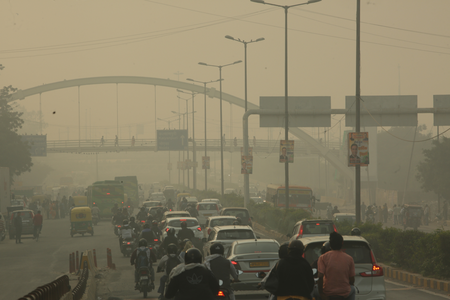
Levels of nitrogen dioxide in the air peaked during evening rush hours and stayed high until midnight, reflecting the impact of traffic congestion, according to an analysis by the Centre for Science and Environment (CSE).
The apex court observed that stubble burning is only one among several contributors to deteriorating air quality and drew attention to the much larger challenge posed by vehicular emissions.
Each winter, images of stubble-burning fields dominate television screens, often reinforcing the perception that farmers are chiefly responsible for the Capital’s toxic air.
The bench of Chief Justice Surya Kant, Justice Joymalya Bagchi, and Justice V. Mohana has now directed Delhi, Haryana, Uttar Pradesh, and Rajasthan governments to submit plans covering vehicular movement, emission standards and measures to curb polluting vehicles.
The Supreme Court noted that during the Covid-19 lockdown, stubble burning had not entirely ceased, yet Delhi witnessed significantly clearer skies, suggesting that factors beyond farm fires play a decisive role in the pollution crisis.
The apex court’s remarks also echoed scientific assessments. Data suggested that stubble burning accounted for around 14 per cent of Delhi’s pollution contribution on November 5, while transportation remained one of the largest local sources of emissions.
The CSE has consistently argued that Delhi’s air quality problem is multi-source in nature, stemming from vehicular pollution, industrial emissions, construction dust, waste burning and adverse meteorological conditions, with crop residue burning acting as an aggravating rather than exclusive factor.
Earlier reports this year by the CSE said that between 1,800 and 2,000 new vehicles are added to Delhi’s roads daily, where, as of 2024-2025, its total registered vehicle count crossed 15.6 million, “with a significant surge in private two-wheelers and cars”.
Additionally, “the number of registered vehicles in Delhi matches the combined total of registered vehicles in the three metropolitan cities of Mumbai, Kolkata, and Chennai”.
According to the Economic Survey of Delhi 2025-26, an additional 643,000 vehicles were added in the national capital, which incidentally is the largest single-year increase in nine years. Farmer unions emphasise that the larger lesson emerging is that Delhi’s pollution crisis cannot be solved through a single-point blame game; while largely acknowledging the need to reduce stubble burning, they urge for solutions to be practical, incentive-based and equitable.
–IANS
jb/vd