

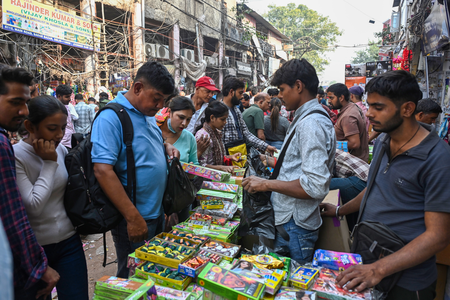
New Delhi, Nov 10 (IANS) The Chamber of Trade and Industry (CTI) has urged authorities to stop holding Diwali firecrackers solely responsible for Delhi’s air pollution, arguing that the issue requires year-round scientific and balanced measures rather than selective restrictions that affect traders’ livelihoods.
In a statement, CTI Chairman Brijesh Goyal said that while the organisation is completely against pollution and wants clean air for Delhi, blaming firecrackers used on a single day for the city’s pollution is not justified.
“Stop the fashion of always making firecracker traders and Diwali firecrackers the villains for pollution,” the CTI said, calling for coordinated efforts with the Central government and neighbouring states to address stubble burning.
Raising questions over the effectiveness of restrictions on firecrackers, the trade body asked whether any credible and accountable organisation could guarantee that Delhi’s Air Quality Index (AQI) would not cross 300 between October and January if firecracker sales were completely stopped.
The CTI said it could persuade Delhi-based firecracker traders associated with it not to set up shops or sell firecrackers next year. However, it questioned whether such a move would guarantee cleaner air during the winter months.
Questioning the argument that firecrackers are the primary cause of Delhi’s pollution, the CTI pointed out that the city’s AQI remained between 350 and 400 on November 5, 6 and 7, even though firecrackers were burst on November 8.
It argued that this demonstrated that firecrackers were not the fundamental cause of Delhi’s pollution and said that blaming them was the easiest approach while ignoring other contributing factors.
The trade body also questioned why pollution levels rise every year between October and January, while the situation remains relatively better from March to September.
According to the CTI, the reason is linked to stubble burning in neighbouring states. It said Delhi’s air quality deteriorates when stubble burning begins and improves when it stops, stressing that authorities should focus on addressing the problem rather than repeatedly targeting Diwali firecrackers.
Highlighting the economic impact of restrictions, the CTI said nearly 10 lakh people across the country are associated with the firecracker industry, from manufacturing units in Sivakasi to retail traders in Delhi.
It said small traders invest capital throughout the year and earn a substantial portion of their annual income during the 15-20 days surrounding Diwali. Last-minute restrictions, it added, leave their investments stranded and cause significant financial losses.
The organisation also questioned why traders continue to be targeted despite manufacturers producing green firecrackers in accordance with court directions.
The CTI further said that children wait throughout the year for Diwali, which brings together new clothes, sweets, diyas and the happiness of celebrating with firecrackers.
“We do not want to teach children that the meaning of festivals is only restrictions,” it said.
Advocating a balanced approach, the organisation said its position was in favour of fewer firecrackers, bursting them during designated hours and promoting green firecrackers rather than imposing a complete ban that takes away children’s happiness.
The trade body also raised questions about what it described as selective enforcement of environmental restrictions during Hindu festivals.
Clarifying that it was not against any religion and respected all communities, the CTI asked why the strictest environmental restrictions and legal interventions were repeatedly associated with Hindu festivals.
It cited restrictions concerning firecrackers during Diwali, water usage during Holi, the Yamuna during Chhath, DJs during Kanwar Yatra and pollution during Ganesh idol immersion.
“Why do the rules, restrictions and legal petitions come first and most strictly in the case of Hindu festivals?” it asked.
The CTI also questioned why similar concerns were not raised with the same intensity over firecrackers burst across the country at midnight on New Year’s Eve.
It further alleged that large quantities of blood and water were allowed to be discharged in the name of traditions and religion without similar public outcry, while Diwali, which it described as one of the biggest festivals of Sanatan Dharma, was repeatedly singled out.
“Our demand is that the law should be equal for everyone,” the organisation said.
Reiterating its demand for accountability, the CTI asked whether authorities could guarantee that Delhi’s AQI would remain below 300 between October and January if firecrackers were completely prohibited.
“If not, then why should firecracker traders be punished?” it asked.
–IANS
rs/dpb


