

New Delhi, Nov 7 (IANS) A module recently busted by the Tamil Nadu police as part of its Operation Deep Source has revealed the increasing use of postal and courier services to smuggle narcotics. There has been an increasing trend whereby narcotics smugglers within India are using postal and courier services to move their consignments.
These operatives are sending out thousands of couriers and posts across the country. However to avoid detection, they use the micro-dosing supply chain which means that each consignment comprises small quantities of just a few grams each per courier or post.
An official said that these people create fake identities and false sender addresses to move drugs. This makes tracking extremely hard for law enforcement agencies.
Further, adopting the micro-dosing method also helps drug paddlers limit exposure and financial loss from a single police intervention, the official said. The idea is to send out thousands of couriers and posts at a time from multiple locations across the country.
Further, these couriers are usually sent to remote villages and smaller towns where screening is very limited compared to the larger cities. The drugs, upon reaching their destination, are picked up and then distributed through couriers to various parts of the country, the official said.
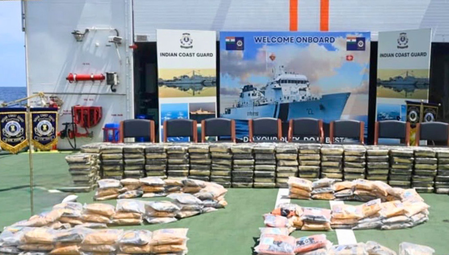
Ever since the Narendra Modi government announced that India would be made drug-free, the agencies have worked overtime. Several operations conducted by the Narcotics Control Bureau (NCB), Indian Coast Guard (ICG) and the state police have led to the busting of multiple modules.
Additionally, the border forces also continue to tackle the drones used to drop off drugs from Pakistan into Jammu and Kashmir and Punjab. Another official said that while the big fish operating from Pakistan, Myanmar and Mexico are effectively being tackled, these smaller operations are becoming a challenge. The quantity of drugs per post or courier may be very small, but it is the volume that is worrying.
On average, drug peddlers look to send out at least 1,000 posts and couriers a day from various parts of the country. The quantity per courier is an estimated 5-20 grams, and this is taking place on a daily basis. This is scaling up the volume considerably and is posing a challenge to the law enforcement agencies, the official said.
The Tamil Nadu police found that parcels had been sent out from Ambala over the last year, and the drugs were meant to reach 19 states and Union Territories. One, Mahender Singh Bisht, was identified as the key coordinator who was operating from Ambala. The supply was being facilitated to the various states by one Sunil Kumar, who was operating out of Jammu and Kashmir, the police learnt.
An Intelligence Bureau official said these persons prefer public postal systems since they are less stringent when it comes to Know Your Customer (KYC) norms. Once the courier or post reaches its destination, the peddlers tell the delivery personnel to call a burner number. The courier or post is picked up at a public space, and this eliminates the risk of tracking to a physical address, the official said.
These persons also deploy the deep-concealment tactic. Using this, they avoid shipping raw bricks of narcotics. Instead, the drugs are hidden inside daily consumer goods. Recent operations have found that MDMA, hashish, and opioids have been smuggled by hiding them inside steam irons and even religious offerings.
These peddlers also specifically sent out such consignments to rural post offices that lack advanced screening facilities and digital infrastructure. The government has instructed private logistics companies to enforce stringent item scanning, mandatory KYC validation, and parcel verification.
Further, state police too are following in the footsteps of the central agencies. Agencies such as the NCB are not just focusing on arrests, but on dismantling the source. Hitting supply chains, targeting the masterminds, and following up with extradition requests has been the NCB’s recent strategy.
The agencies will face new challenges as they continue dismantling the narcotics networks. Consistency would be the key in achieving the vision of a drug-free India, an official said.
–IANS
vn/skp