

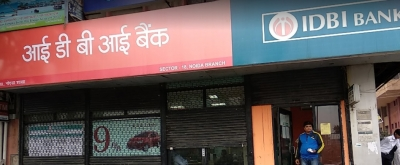
New Delhi, Oct 30 (IANS) The government on Friday issued a clarification on the process of ‘strategic restructuring’ of IDBI Bank, saying the government of India and the LIC retain residual shareholdings to get further benefit from the “upside that is expected from the value enhancement following strategic restructuring of the IDBI Bank going forward in future”.
Finance Minister Nirmala Sitharaman had earlier described the IDBI Bank deal as a “strategic restructuring” rather than a strategic disinvestment — highlighting that both the government and LIC will remain shareholders in the lender after the transaction is completed.
The Finance Ministry said in a fresh statement that the first or initial bid round was conducted in the financial year 2025-26 by DIPAM as per its internal practices, which are in the nature of indicative guidelines and not hidebound rules or regulations.
“The foreword itself states that the procedure suggested is not to be construed as a rigid, legal framework, which may require due adaptation/ modification in the best interest of successful execution of the transaction in a time bound manner. Given the complex nature of strategic transactions, the indicative guidelines give flexibility to ensure cost and time spent in lengthy processes is not wasted,” it explained.
The press note “dated 14.10.2026 clearly explains that there is not a-priori benchmark for bidding”.
The bidders do their own valuation and submit their bids in a confidential manner. Independent agencies are hired to do a fair valuation of the enterprise contemporaneously, which is then used as a comparator to assess the reasonableness of the bids submitted. The bid discovered price and the comparative valuation can, therefore, be above or below each other, the ministry statement further added.
To handle this situation, provision is ex-ante built into Para 5.3.6(iii) the RFP: “In the event the Financial Bid of the Highest Bidder is lower than the reserve price, the Gol will decide the further course of action and the QIPs shall not subsequently question any decision taken by the Gol in this regard.”
There is no procedure prescribed to handle this situation internally within DIPAM and special powers have been delegated to the Core Group of Secretaries on Disinvestment (CGD) by the Cabinet Committee of Economic Affairs (CCEA) for this purpose, said the ministry.
“In its meeting dated August 16, 2017, while approving the Note titled ‘Procedure and Mechanism for Strategic Disinvestment – Delegation Thereof’, the CCEA has empowered the CGD to remove all difficulties, including deviations from procedure, to ensure effective implementation of the strategic disinvestment transactions approved by the CCEA,” the statement explained.
The entire valuation methodology was reviewed by the CGD in April, 2026 before the invitation of best offer bids.
“Since the comparator used for valuation has to be contemporaneous with the bids received, and 31st March, 2026 closing financial accounts were released in the public domain in end-April, the independent valuation agencies had started working on the revised valuations in May, 2026 itself. The process remained double blind because the bidder did not know the valuation and the valuators did not see the bids. It is only the CGD which gets to see a complete picture and compares the bids with fair valuations to take a final call on the reasonableness of the bids submitted,” the statement further explained.
The valuation was carried out by two different advisers, independent of each other, using independent and distinct methodologies. The Asset Valuer also used robust and time-tested methodologies, including additional value for disputed tax demands, which were indemnified as a common demand of the qualified bidders to nudge the bid offer upwards, said the ministry.
“This remains a low probability event and revenue neutral for the government, as only the additional tax demand, if paid at all, will be eligible for reimbursement. The potential liability that could arise on this account was only Rs. 627 crores while the bid discovered price increased by Rs 3,917 crore enhancing the value of the transaction for the GoI and the LIC,” it noted.
The CCEA earlier approved the sale of a 60.72 per cent stake in IDBI Bank to Canada Inc., a subsidiary of Fairfax Financial Holdings, for Rs 52,878 crore.
The transaction includes the sale of 30.48 per cent stake held by the Government of India and 30.24 per cent stake owned by the LIC. Following the transaction, the government will retain a 15 per cent stake, while LIC will continue to hold 19 per cent in the bank.
—IANS
na/