
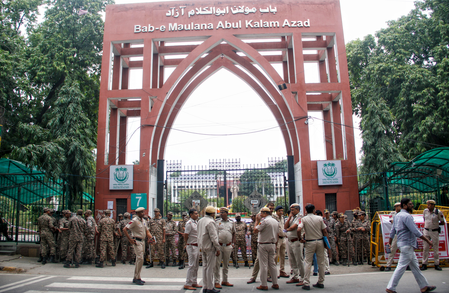
New Delhi, Oct 29 (IANS) Students at Jamia Millia Islamia University’s Centre for West Asian Studies and Department of Sociology on Thursday announced “complete boycott” of the varsity’s online classes order, citing “disruption of academic progression and research work”, and demanded immediate restoration of on campus classes.
This comes as protests demanding the restoration of the Jamia Millia Islamia Students’ Union (JMISU) and the removal of the University’s Chief Proctor over a crackdown on protestors, entered its 18th day on Thursday.
In an official statement, the Centre for West Asian Studies (CWAS) students expressed their complete rejection of the university’s order on Thursday that directed the extension of the ongoing online classes till November 24 and announced that all practical and theory examination of Odd semester students will be held via virtual mode, considering that the situation at the campus is “not conducive” for academic environment.
“The decision to indefinitely extend online classes until the end of the semester and deny physical access to the university campus disrupts our academic progression, research work, and institutional engagement without providing a definitive timeline or engaging in student consultation,” the statement read.
Citing the importance of physical access to the University Campus, the CWAS said: “For scholars and students at the Centre for West Asian Studies, access to the central library, physical archives, specialised journals, and primary reference materials is fundamental to our coursework and research requirements. These academic resources cannot be replicated or replaced through online platforms.”
“Furthermore, many students continue to bear the financial burden of hosteling, rented accommodation, travel, and daily living expenses in Delhi, expecting the university to fulfill its commitment to providing an on-campus educational environment,” it added.
“In solidarity with the student body and in defence of our academic rights, the students of the Centre for West Asian Studies hereby declare non-cooperation and announce a complete boycott of online classes until normal physical academic operations and campus access are restored,” the students declared.
“We further clarify that any individual participation in online classes driven by attendance requirements or administrative policy does not constitute voluntary acceptance or collective consent regarding this order,” the statement said.
Issuing a Charter of Demands, students at CWAS sought immediate campus restoration, definite operational schedule, constructive administrative engagement, deadline for constitutional draft and academic protection.
Similarly, Student Subject Association of JMI’s Department of Sociology also declared “complete rejection” of the decision to extend online classes until the end of the entire first semester.
“Such an arbitrary extension of online education, without a definite timeline or meaningful consultation with students, is unacceptable. If students had wanted to pursue their education entirely online, they could have opted for distance-learning programmes,” an official statement said.
The Sociology Department’s Student Subject Association also echoed concerns of accommodation, food, travel, and other living expenses of students.
Moreover, it stated that the protesting students “are not the enemy” of the institution and “neither a threat”.
“If protestors have become a nuisance, then administration should simply give them the deadline of constitutional draft and put this all to an end once and for all. Institutional authority must not be exercised in ways that effectively penalise the wider student community for demanding accountability,” it said.
Asserting that the department’s students have by their “own will” and “collective agreement” decided to resume the boycott of online classes, the statement added that even if a small number of students whether two, five, or any other number attend the virtual classes under “pressure” arising from attendance requirements, academic uncertainty, or the fear of adverse consequences under university policies, “their participation cannot be interpreted as collective acceptance of the administration’s decision.”
–IANS
cg/rad