

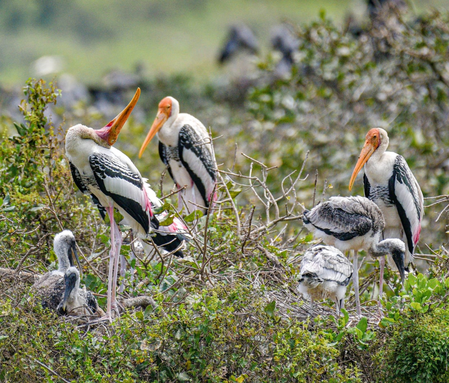
Kolkata, Oct 22 (IANS) It is water availability that determines when colonial waterbirds begin breeding, how large their colonies become, and how many species a wetland can support, the Wildlife Institute of India (WII) has found.
Securing suitable hydrological conditions will be essential to the conservation of colonial waterbird populations in the face of increasing climatic variability, the study has revealed.
The study was conducted in the monsoon-dependent wetlands of southern India, and the findings were published on October 21, 2026. The study involved combining systematic field surveys over three consecutive breeding seasons (2022–2023 to 2024–2025), satellite imagery and climate data.
It documented 16 species and revealed that wetland water extent was the strongest predictor of nesting occurrence, colony abundance and species richness.
Greater inundation was associated with a higher probability of colony establishment, larger breeding colonies and greater species diversity, it was revealed.
“Conservation planning must move beyond individual wetland boundaries. Conservation strategies should prioritise the maintenance of adequate water levels during breeding seasons through effective management of reservoirs, irrigation systems and canal networks supplying water to such biodiverse-rich wetlands,” the WII, an autonomous body under the Ministry of Environment, Forest, and Climate Change (MoEFCC), has said.
The research was supported by the Anusandhan National Research Foundation (ANRF), Government of India, underscoring the importance of integrating hydrological monitoring, climate information and long-term ecological surveys to strengthen wetland conservation.
Wetland ecosystems are highly sensitive to environmental variability, but the relative importance of hydrological and climatic drivers of colonial waterbird breeding is poorly understood in landscapes that depend on the tropical monsoon, researchers have said.
“We investigated the influence of wetland inundation and climatic conditions on the occurrence of nesting, colony abundance and species richness of colonial nesting waterbirds across nine wetlands in Tamil Nadu, India, over three breeding seasons (2022–2023 to 2024–2025),” the institute said.
Breeding responses were quantified through systematic field surveys and related to wetland water extent derived from Sentinel-2 imagery and climatic variables obtained from the ERA5 reanalysis dataset.
“We measured the effects of water extent, temperature, precipitation and wind speed with generalised linear mixed models. A total of 16 colonial nesting waterbird species were recorded. Environmental conditions during the 30 days preceding surveys consistently provided the strongest explanation of breeding responses. Water extent emerged as the dominant predictor of nesting occurrence, colony abundance and species richness. The nesting probability increased significantly with water extent, whereas colony abundance and species richness increased with greater inundation,” it said.
While maximum temperature negatively affected colony abundance and species richness, precipitation had weaker negative effects and wind speed had no significant effect.
Thereby, the findings indicate that the main driver of colonial waterbird breeding dynamics in monsoon-dependent wetlands is wetland inundation, while climatic factors exert secondary effects on colony performance and diversity.
–IANS
jg/dan