

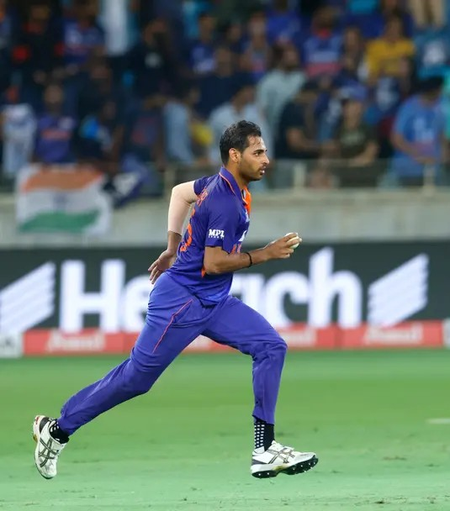
New Delhi, Oct 21 (IANS) Recalled veteran pacer Bhuvneshwar Kumar can be lethal with the new ball if New Zealand’s early-season pitches offer swing and seam, apart from him bringing a calming presence to India’s bowling line-up in the upcoming T20I series starting on Thursday, said former Black Caps fast bowler Shane Bond.
Bhuvneshwar returned to India’s T20I squad for the first time in nearly four years, when he recently featured in the washed out series decider against the West Indies in Bengaluru. The veteran pacer earned a recall for the T20I tour of New Zealand after his standout performances helped Royal Challengers Bengaluru secure consecutive IPL titles in 2025 and 2026.
“It’s great to see Bhuvi back in the international circuit. He’s a great bowler and has been so good in the IPL for so long. What it’s like to have someone like him in the team is just a calming influence. He’s bowled in big moments so often and always is a man who looks up for it and always looks calm and composed in those moments.
“It’s always nice to have a senior bowler in your team, particularly in those death overs where, alongside the captain, you can lean on. So, he’ll be stoked and deserves his chance back in the team. I’m looking forward to watching him bowl, particularly in conditions that might swing and seam because he can be lethal with the new ball, let alone being a quality finisher,” Bond told IANS in an exclusive conversation.
He also felt the timing of the T20I series will heavily favour the seamers. “If you’re going to play against India at home it’s probably a good time of the year to play them, particularly if you’re a fast bowler, because they do have such an imposing batting lineup.
“Usually in New Zealand, that’s the difference maker – the better-performing fast bowling group is likely to win you a series. It’s early season here and you’re playing on a mixture of drop-in pitches and traditional wickets Christchurch and other varied-sized grounds. But I’m certainly expecting there to be bounce and some sideways movement,” added Bond.
Bond said the bowlers’ lengths would stay largely the same in the shortest format, though the biggest question is about the nature of pitches in Christchurch, Wellington, Auckland and Hamilton. “Generally with the length in T20Is, it doesn’t change too much. You’re looking to sort of hit a 6-7 metre length and look, if you’ve got any sort of sideways movement and bounce in any wicket, that’s generally the toughest length to bowl.
“Then obviously, it’s just the batsmen who are going to come out and attack and try and knock you off that length and get you to do different stuff. The bigger question is, are the wickets going to swing and seam in particular?
“Because if you find that length consistently and the ball does move, then it becomes very difficult. So that’s probably the unknown going into this series, particularly at this time of the year. There is going to be a lot of movement for the fast bowlers and what sort of impact that may have on the series will be keenly seen.”
Bond also sees the T20I series as a useful rehearsal for India’s younger quicks ahead of the next T20 World Cup, to be co-hosted by Australia and New Zealand, in 2028. “Obviously, guys like Prince Yadav, who had a very good IPL. In all, the Indian bowling attack is a fast attack.
“They’ve certainly got pace and if you look forward to the next World Cup that will be played in New Zealand and in Australia, there’s this opportunity to bring some young bowlers over who could potentially make that team to experience the conditions, training conditions, and just what it’s like to travel around New Zealand and places to eat.
“Little things like that can make a difference just through having experience here, as well as the (India) A team that’s actually here as well. All those things add up when you’ve got a big tournament that’s only, what, now a year and a half away. So, both teams have quality fast bowling groups and that goes across all three formats.”
Bond said the bigger adjustment would fall on India’s batters and fielders, considering they have very little time to practice in Christchurch. “It’ll just be for India to adapt to the pace and the bounce and maybe the movement of the wickets here. The cold might be a factor as well.
“The games are starting late and at this time of the year in New Zealand, the weather can be pretty chilly and windy. So particularly coming off a home series, that can present a little bit of a challenge to the fielding department. It’s always easier with the ball – the lengths don’t change too much. But the bigger challenge is just for the batsmen, particularly when playing in this early season.”
Varied ground sizes could also shape selection and tactics for both India and New Zealand, opined Bond. “One of the intimidating factors of playing New Zealand is the ground size. Hamilton’s sort of like Chinnaswamy – to be fair, there’s a little bit of similarity there. Eden Park’s probably the biggest one, where they hit down the ground like 45 metres, and people always struggle with that.
“Even though the wicket has pace and bounce, generally it makes for a real difficult place often for spinners to bowl, and teams generally just try and hit over the top of the stumps because the bigger boundary is the square of the wicket. Eden Park and Wellington have drop-in wickets, so they present a slightly different challenge.
“Christchurch is probably the more traditional size cricket ground with a normal cricket block, so it’s a good place to start the series. But ultimately, if the wickets are true and the grounds are small, there’s going to be big runs. You just have to turn up and get to execute plans.
“Both teams are pretty used to that now when you see the volumes of runs scored in the IPL. So, expect some high-scoring games, particularly in the back end of the series where the teams sort of find their feet when playing again, and that’s what the crowd wants to see.”
–IANS
nr/bc