
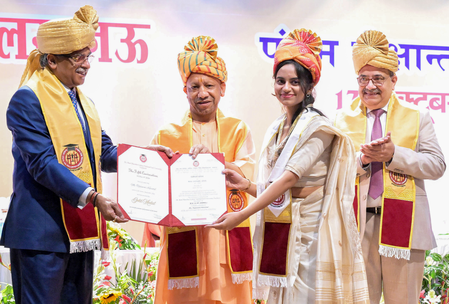
Lucknow, Oct 17 (IANS) Uttar Pradesh Chief Minister Yogi Adityanath said on Saturday that the Emergency imposed in 1975, helped the country to differentiate between “Rule of Law and Ruler of Law”.
Addressing the fifth convocation ceremony of Ram Manohar Lohia National Law University in Lucknow, the Chief Minister asked the graduates to consider their case number as ‘2047-Viksit Bharat’, whose petitioners are 140 crore Indians.
“The opponents in this case are those who believe that this development is not possible in any case. You have to fight this case against those stubborn opponents who are not ready to hear any arguments and do not believe any evidence,” he said in a veiled reference to the Opposition.
CM Adityanath said that the “first date of the case” fell on August 15, 1947, when India attained Independence.
“There were many lawyers who led the freedom struggle and then there were several lawyers in the Constitution drafting committee. The last date of the case that I have handed you ‘2047-Viksit Bharat’, falls on August 15. You are the ones who have to do its advocacy and hence have to prepare yourself for that.”
“The second date of the 1947 case fell on January 26 when India adopted its Constitution. Every Indian, and every institution in the country is bound by this one book. The most important document to realise our vision of ‘Ek Bharat Shreshth Bharat’ is the Constitution of India,” he added.
Chief Minister Adityanath remarked that “third date” in front of the nation was June 25, 1975.
“This is the same Uttar Pradesh whose High Court had declared the election of the person sitting on the country’s most powerful chair (Indira Gandhi) as void. Thirteen days after that, Emergency was imposed as a response to it,” he said.
Referring to Justice H.R. Khanna’s lone dissent from the majority order during the 1975–1977 Emergency, CM Adityanath said: “In 2017, the Supreme Court considered that dissent as correct.”
The Chief Minister added: “1975 (Emergency) taught the country, the difference between ‘Rule of law’ and ‘Ruler of law’… It was the ‘Rule of Law’ under which the apex court, in 2017, had upheld Justice H.R. Khanna’s dissent.”
He said that another date of “India’s case” fell on May 16, 2024, when BJP won a majority in the country and Prime Minister Narendra Modi was voted to power.
Emphasising that PM Modi worked for “reform express” in the nation, the Chief Minister said: “He ended all those laws in the country which had become obsolete.”
Referring to his coming to power as Uttar Pradesh Chief Minister, Yogi Adityanath said: “In Prayagraj, there used to be a mafia, whichever land he stepped onto became his. He did not abide by law, not even the Chief Minister or Governor. Earlier, there was ‘rule of mafia’ in the state, we implemented the ‘rule of law’ which made it possible to bring in reforms here.”
He urged young lawyers to become the “main character”, while citing Lord Krishna’s advice to Arjun in the holy Bhagwat Gita.
Using the Gen Z lingo “touch grass”, CM Adityanath said: “Your generation is told to “touch grass”, to look away from screens and explore the world. My advice to you is — try to touch the mud of your villages, try to look at your roots because the stronger your roots are, the longer will be the journey of India’s democracy.”
The Chief Minister appealed young advocates to help resolve land and family disputes in rural areas, oppose injustice and remain steadfast in their principles despite external pressure.
He also urged the students to “protect their aura”.
“There will be moments in your career where you will be asked to manage. Remember it is a ‘redflag’ as there is no shortcut to success,” CM Adityanath said.
Citing software updated in mobile phones and amendments in law, the Chief Minister urged the young advocates to stay updated.
“Rather than sticking to the screens always, you should engage in activities to remain updated,” CM Adityanath advised the students.
He added that the convocation ceremony is a “core memory” for the students and “fruit of hardwork and dedication” for their parents.
–IANS
cg/khz