

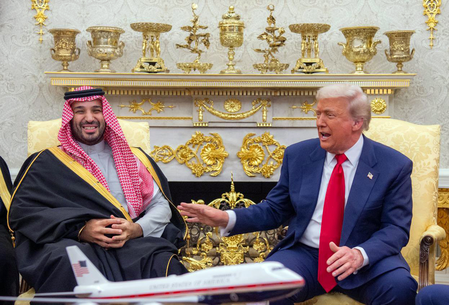
Washington, Oct 16 (IANS) Two Democratic US senators introduced a resolution seeking to block President Donald Trump’s civilian nuclear cooperation agreement with Saudi Arabia, warning that the deal lacks safeguards needed to prevent a nuclear arms race in the Middle East.
Senators Jeff Merkley of Oregon and Edward Markey of Massachusetts introduced the joint resolution of disapproval, setting the stage for a Senate vote after November 29, before the proposed agreement takes effect.
The move marks a new congressional challenge to the administration’s nuclear diplomacy with Riyadh.
Under federal law, Congress has a 90-day review period to examine the agreement. Unless Congress adopts a resolution blocking it, the agreement can enter into force after the review period.
Merkley, a senior member of the Senate Foreign Relations Committee, said the United States must insist on strong safeguards before transferring civilian nuclear technology to Saudi Arabia.
“Giving Saudi Arabia access to US civilian nuclear energy technology without ironclad protections to make sure it doesn’t provide a foundation for a nuclear bomb is unacceptable,” Merkley said.
“We can’t sleepwalk into a decision this consequential,” he said, stressing Congress’s responsibility to scrutinise the agreement.
Markey went further, warning that the proposed arrangement could destabilise an already volatile region.
“The US-Saudi nuclear deal is about megatons, not megawatts,” he said.
He accused the administration of pursuing an agreement that falls short of established non-proliferation standards, particularly by allowing uranium enrichment without requiring the strongest international inspections.
“This deal is the starting gun for a Middle East nuclear arms race. Congress must reject it,” Markey said.
The senators contend that the agreement fails to meet two safeguards they consider essential.
The first is the so-called gold standard for civilian nuclear cooperation, under which a recipient country commits not to enrich uranium or reprocess spent nuclear fuel.
Both activities can have legitimate civilian applications but also involve technologies that could contribute to the production of nuclear weapons material.
The second is adherence to the International Atomic Energy Agency’s Additional Protocol, which provides inspectors with broader access and information to help detect undeclared nuclear activities.
According to the senators, the absence of these conditions could create incentives for other regional powers to seek similar concessions.
They specifically cited the United Arab Emirates, whose nuclear cooperation agreement with Washington incorporated stronger restrictions on sensitive nuclear activities.
The senators warned that offering Saudi Arabia more favourable terms could encourage the UAE to reconsider its existing commitments.
They also expressed concern that Iran could resist future restrictions on its nuclear programme if Saudi Arabia were permitted to pursue capabilities denied to Tehran.
The proposed resolution would block the US-Saudi agreement if enacted. Its introduction does not, however, suspend the agreement or establish that Congress has rejected it.
The initiative follows earlier demands from lawmakers for greater transparency over the proposed agreement, including access to two accompanying side letters that the administration has classified.
Civilian nuclear cooperation agreements under Section 123 of the US Atomic Energy Act establish the legal framework for transferring specified nuclear materials, equipment and technology to foreign partners. They are subject to congressional review because of their implications for nuclear non-proliferation and national security.
–IANS
lkj/rs