

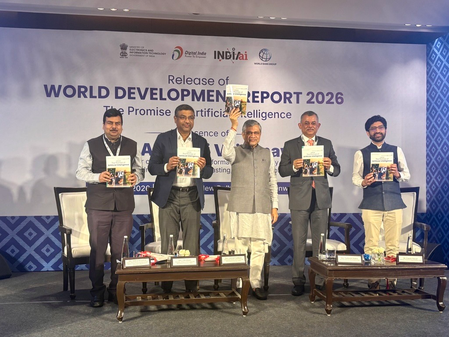
New Delhi, Oct 8 (IANS) India’s progress in AI holds lessons for the wider developing world, as the country’s huge strides in AI is not just addressing its own problems but broader development challenges for the world, Dr Michael Kremer, Chief Economist and Senior Vice President, World Bank Group, said on Thursday.
Speaking at the launch of the World Bank Group’s ‘World Development Report 2026: The Promise of Artificial Intelligence’ here, he said that “For the scale up of AI solutions, we need a full stack approach – not just elements of the software but humans and institutional elements that come along with it.”
Dr Kremer cited India’s AI-based monsoon forecasting as an example for the world.
The government, through its meteorological agencies and the Ministry of Agriculture, tested and combined multiple AI models, including open-access models, and delivered the forecasts to millions of farmers through text, voice and AI-powered advisories.
The model predicted the unusual 2025 monsoon, and Ethiopia is now following India’s lead. He said the case shows that where commercial incentives are weak, but the social potential is high, government has an important role to play.
The report notes that AI can widen access to expertise, raise productivity, and improve the delivery of services in developing economies.
AI-enabled tools are already being deployed in medical screening, agricultural decision-making and education, extending scarce expertise to larger sections of the population.
The report emphasised that these gains rest on strong foundations, including reliable electricity and connectivity, computing infrastructure, quality data, skills, education systems and capable institutions.
Union Minister Ashwini Vaishnaw underlined India’s approach of democratising technology, so that the benefits of Artificial Intelligence reach citizens, enterprises and institutions across the country.
“AI is changing the lives of ordinary people. In Baramati, sugarcane yields rose by 40 per cent with 30 per cent less water and fertiliser, for farmers who have never used a computer simply through voice on a phone. In healthcare, TB detection has increased by 35 per cent. Examples like these can change lives across the Global South and the world,” said Vaishnaw.
India has emerged as a significant ecosystem for the development and deployment of AI, with applications in healthcare, agriculture, education, governance, financial services and other sectors of public and economic importance.
Through the IndiaAI Mission, the government is building a comprehensive AI ecosystem across seven pillars: IndiaAI Compute Capacity, IndiaAI Innovation Centre for indigenous foundation models, IndiaAI Datasets Platform (AIKosh), IndiaAI Application Development Initiative, IndiaAI FutureSkills, IndiaAI Startup Financing, and Safe & Trusted AI.
—IANS
na/