

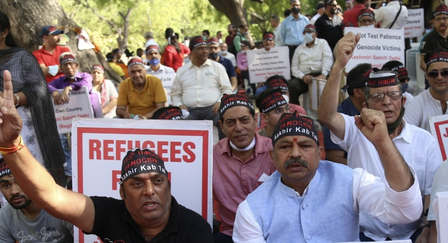
New Delhi, Sep 6 (IANS) There can be no greater terror than seeing your name, occupation, contact numbers, residential address, and details of your family and relatives publicly marked by terrorists. And the only reason for this is that you are a Kashmiri Pandit — an original dweller of Kashmir trying to return and reclaim the land of your ancestors.
This is the reality of 2026. And it is not very different from what happened when the persecution began in the 1980s and exploded in the 1990s. The threat, harassment, and targeted killings never really went away. They have continued in different forms over the years.
The terror groups are the same, even if some now operate under different names. Their backers remain the same, sitting in Pakistan, Turkey, and other countries, as well as in Kashmir. Some politicians and separatist-supporting outfits remain around too. And the objective has not changed — an Islamic Kashmir and the complete elimination of Kashmiri Pandit influence and presence from the Valley.
When former J&K Chief Minister Farooq Abdullah dismissed the recent threat letters received by Kashmiri Pandits, it showed a mindset that has often been seen as sympathetic to separatist thinking. His bizarre argument was that if Kashmiri Pandit employees were receiving threats, why were senior Hindu officers posted in the Union Territory not being threatened? He knew exactly what he was saying. And yet, he said it.
Farooq Abdullah and those like him know very well that Kashmiri Pandits have been trying to return to their homeland. Some have made individual efforts, while others have returned in groups. A small number have tried to resettle in different parts of the Valley.
Then there are those who returned in 2008 under the Rs 16,000-crore rehabilitation package announced by former Prime Minister Manmohan Singh. They took government jobs in different departments, but under strict conditions. They had to work in Kashmir or risk losing their jobs and were provided accommodation in gated settlements.
According to Union Minister of State for Home Affairs Nityanand Rai, in a July 26, 2022 reply to a Lok Sabha question, 5,502 Kashmiri migrants had been provided government jobs under the Prime Minister’s Development Package. The migrants included Kashmiri Pandits and other religious communities as well.
So, when three threat letters emerge one after another, on August 3, 23, and 27, why would those Kashmiri Pandits living in the Valley not be afraid?
Threat letters are not new to Kashmiri Pandits. They were part of the terror campaign that began in the late 1980s and drove thousands of Hindus out of the Valley in the 1990s. Hit lists were prepared and pasted on walls and houses. Kashmiri Pandits were abducted and tortured on allegations of being Indian agents or RSS members.
Hundreds were killed. Some were brutally murdered, their bodies hung from poles and trees. Some were killed in sawmills. Others were beheaded, with their heads thrown into Hindu courtyards.
This was happening in the late 1980s and 1990s, when Farooq Abdullah was Chief Minister of the erstwhile J&K state under Article 370 and Article 35A, while Mufti Mohammad Sayeed, father of Mehbooba Mufti, was the Union Home Minister. Then there were also mass killings in which Kashmiri Pandit men, women and children were lined up and shot dead in the years that followed.
This is the history that cannot simply be wished away. So when threat letters resurface, how responsible is it to ask why other Hindu officers are not being targeted?
The real issue is not who else has not been threatened, as Farooq Abdullah wants it to be believed. The real issue is why Kashmiri Pandits, who have returned to their homeland to work and rebuild their lives, continue to live under such fear.
Had the political class been genuinely interested in their return, far more would have been done to help this beleaguered community and restore the real meaning of Kashmiriyat.
Kashmiriyat was never about erasing differences. It was about Kashmiri Pandits and Muslims living together while respecting each other’s religious boundaries. It was about a society where two distinct communities could coexist with discipline, mutual respect, and a sense of community. That Kashmir has been shattered.
And those who should have stood up for the Valley’s minuscule minority have largely remained silent. They did little when Kashmiri Pandits were persecuted and have done little since to create a social narrative within the majority community that encourages their return. That silence has consequences.
For the Kashmiri Pandits living in the Valley today, this is not a political argument. It is about survival and the simple right to live without looking over their shoulders. Most of them are afraid to move freely or even attend offices.
The most disturbing question is how terrorists managed to get such precise information about those being threatened — their mobile numbers, workplaces and Jammu-based postal addresses.
The nexus is well entrenched. It could include a neighbour, colleague, classmate, business partner or simply anyone with access to such information. It was there in the 1990s and has never gone away.
The aim is clear — never to let Kashmiri Pandits return to their homeland and to create such fear, from time to time, that those who have returned are forced to think twice before staying back. That, perhaps, is the real terror.
(Deepika Bhan can be contacted at deepika.b@ians.in)
–IANS
dpb/sd/