

Colombo, Sep 2 (IANS) India’s democratic achievement lies not merely in conducting elections on an extraordinary scale, but in the sustained effort to make the electoral process “accessible, auditable, technology-enabled and participatory”. The evolution of India’s electoral democracy is ultimately a story of scale coupled with institutional adaptation, a report has stated.
From universal adult franchise at independence to electronic voting, Voter Verifiable Paper Audit Trail (VVPAT) units, digital voter services, webcasting, voter education and international electoral cooperation, the electoral system has evolved through successive innovations while upholding the core principle that political power derives from the citizen’s vote, Sri Lanka-based ‘Asian News Post’ mentioned.
“When nearly a billion citizens are eligible to vote, democracy stops being an abstract constitutional principle and becomes a vast exercise in organisation, participation and public trust. In India, the scale of that exercise is matched by an increasingly technology-enabled electoral system, a constitutional election authority and an expanding effort to make the ballot accessible to citizens across age groups, regions and social backgrounds,” the report stated.
“The world’s largest democracy has continued to evolve its electoral architecture since independence, combining universal adult suffrage with institutional safeguards, digital tools and voter-focused reforms. The 2024 Lok Sabha election demonstrated the scale of this democratic participation, while developments through 2025 and 2026 have further emphasised transparency, accessibility and technology in election management,” it added.
According to the report, the Election Commission follows a broad transparency framework covering voter registration, polling, counting and post-election procedures.
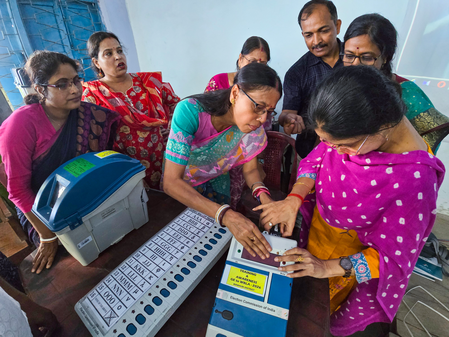
Political parties and candidates are involved at various stages, including the preparation and verification of electoral rolls, checking of electronic voting machines and VVPAT units, randomisation, commissioning, transportation, storage and counting.
“Electronic voting machines are supported by VVPAT technology, which allows voters to see a printed slip showing the candidate they selected. The slip remains visible for about seven seconds before automatically dropping into a sealed compartment. The system creates a physical audit trail alongside electronic vote recording,” the report mentioned.
It noted that the Commission has also broadened its use of digital monitoring tools. Citing the Government’s National Voters’ Day 2026 backgrounder, the report said 100 per cent webcasting at polling stations has enhanced oversight of activities on polling day.
“The Commission has also developed digital systems for voter services, turnout reporting and election management, while cVIGIL enables citizens to report violations during elections. Such measures reflect an important evolution in election administration: transparency is increasingly being designed into the process rather than treated solely as a post-election requirement,” Asian News Post highlighted.
The report emphasised that a robust democracy is measured not only by the number of people eligible to vote but also by the extent to which every section of society can participate in the electoral process. India’s election machinery, it said, has consequently placed greater emphasis on senior citizens, persons with disabilities, women, young voters and those living in remote areas.
–IANS
scor/as