

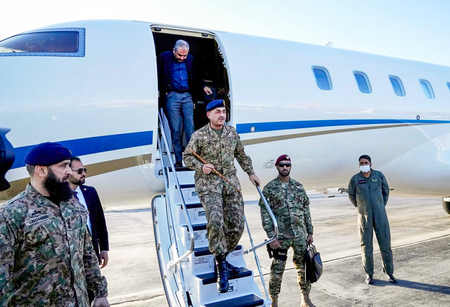
Washington, Aug 29 (IANS) Pakistan has experienced military rule before, but under Army Chief Asim Munir, the country appears to be entering a different phase — one in which military dominance is being institutionalised rather than imposed through an outright takeover, a report has stated.
It noted that instead of overthrowing civilian rule, the military is increasingly embedded in the constitutional, judicial, economic and administrative machinery of the state.
The Defence Forces of Pakistan Act, 2026 marks perhaps the most decisive step yet in entrenching military supremacy under Munir, according to a report in the US-based Middle East Media Research Institute (MEMRI).
“Passed on August 20, 2026, amid an opposition walkout, the law gives the Chief of Defence Forces (CDF) operational command and control over Pakistan’s armed forces. It also extends the CDF’s authority over organization, administration, readiness, tri-service operations and personnel matters, including powers relating to the retirement, discharge, release and retention of members of the Army, Navy, and Air Force,” the report detailed.
“The legislation translated the constitutional position of CDF into a permanent operational and administrative system. With Munir simultaneously holding the offices of Chief of Army Staff and Chief of Defence Forces, the law further concentrates authority over all three armed services in one office. The CDF is also Army Chief, holds the five-star rank of Field Marshal, enjoys an extended tenure and operates at a time when civilian checks on military influence have progressively weakened,” it noted.
The report argued that the authoritarian trajectory of Pakistan’s military becomes evident when expanding institutional reach is coupled with the shrinking of civic space.
Citing a US-based advocacy group, Human Rights Watch report, it said the year 2025 witnessed intensified repression of dissent, journalists, political opponents and civil society. This included “arbitrary detention, restrictions on media coverage, disruption of communications and the prosecution of civilians through military courts.”
Referring to American think tank Freedom House’s 2026 findings, the report further noted the “military intimidates the media and enjoys substantial impunity, while its internet-freedom assessment classifies Pakistan’s online environment as ‘Not Free’.”
It stressed that the pressure has persisted into 2026, citing an August 2026 joint appeal led by Amnesty International that documented mounting restrictions on journalists and lawyers, punitive measures against broadcasters, prolonged internet disruptions in Pakistan-occupied Kashmir, and new curbs on the movement of foreign journalists outside Islamabad, Lahore and Karachi.
Highlighting the widening crackdown by the Pakistani military, the report said pressure is increasingly reaching critics living overseas.
“Freedom House warned in March 2026 of an intensifying Pakistani campaign of transnational repression, particularly involving legal harassment of exiled journalists and dissidents. Seven exiled journalists and commentators had been sentenced in absentia to life imprisonment, while British authorities were reportedly treating physical intimidation against Pakistani dissidents as possible transnational repression,” it noted.
–IANS
scor/as