
United Nations, Aug 21 (IANS) US President Donald Trump’s administration is clashing with General Assembly President Annalena Baerbock, accusing her of trying to “undermine” the election process for the next secretary-general through her demand for “transparency”.
It is a conflict that pits the Security Council’s permanent members against the broader membership represented by the Assembly, which would like to see a more open process instead of a backroom deal among the Council’s permanent members.
And the US has the support of Russia, which feuds with it on most issues, virtually paralysing the Council.
The accusation came ahead of the second straw poll the Security Council is holding on Friday to informally assess the support levels of the eight candidates who are vying to succeed Secretary-General Antonio Guterres, whose term ends this year.
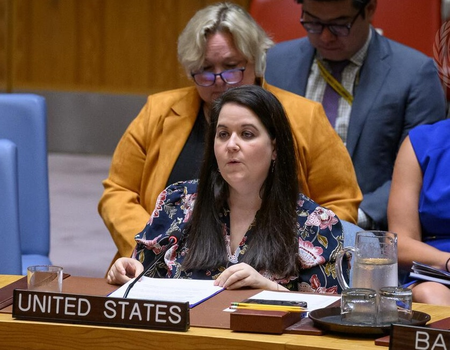
US delegate Jennifer Locetta told the Security Council on Wednesday, “The United States takes exceptional issue with the President of the General Assembly’s overreach and irresponsible actions in this process, the sum of which may serve to undermine the important selection process”.
The root of the conflict lies in the demand for transparency by Baerbrock, reflecting the views of most members of the UN, in the election process that has been reduced to virtually secretive negotiations among the permanent members of the Council.
The Council’s permanent members hold the key to the election of the secretary-general as they can veto a candidate.
The General Assembly votes on the candidate recommended by the Council, by tradition a rubber-stamping process.
The five permanent members zealously guard their prerogative, and not surprisingly, Russia’s Permanent Representative Vasily Nebenzya said on Thursday that he agreed with the US allegation that Baerbrock had overreached.
Setting out the conflict between the Council and the Assembly, which represents all the 193 members of the UN, Locetta said, “The PGA [Assembly President] continues a trend of UN leadership fancying themselves as diplomatic superstars rather than Chief Administrative Officers”.
Locetta, who is the US Alternative Representative for Special Political Affairs, took exception to two letters Baerbrock sent the Council.
In one, she had called for “transparency”, “fairness”, and “inclusion”, which Locetta said was “insinuating that it [the Council] acted improperly”.
In the other, she had asked the Council not to consider the latecomers to the election process who had not appeared before the General Assembly.
The US representative also objected to an informal poll taken of the audience after a town hall meeting of the candidates the General Assembly hosted in cooperation with the Bloomberg media and financial services organisation.
“Most people who voted in the poll have no official role in the selection process of the Secretary-General. This polling was unfair, untransparent, and unprecedented”, Locetta said.
“The President’s actions expose a hypocrisy and reflect poorly on the General Assembly’s work writ large”, she said.
In that poll of the town hall audience comprising diplomats and others, Guyana Foreign Minister Carolyn Rodrigues-Birkett got 49 votes, the most.
UNCTAD head Rebecca Grynspan came next with 14 votes and Maria Fernanda Espinosa, a former Assembly president and Ecuador’s foreign minister, followed with 10.
At the straw poll held by the Council last month, Grynspan led with ten positive votes, one negative, and four neutral votes, and Rodrigues-Birkett followed with nine positive, two negative and four neutral votes.
It was not known if the negative votes were cast by permanent members.
More straw polls will follow the second on Friday, with final ones where the permanent members’ votes will be colour-coded while keeping them anonymous.
The process will end when a candidate finally gets at least nine votes, without veto-bearing votes of the permanent members.
Two new candidates have entered the fray since the last straw poll.
Ivonne A-Baki, an Ecuadorian of Lebanese descent who was that country’s ambassador to the US and France, was nominated by Tonga and will challenge Espinosa, who is also from Ecuador but was nominated by Antigua and Barbuda, another small island nation.
The other latecomer is a Ugandan, Olara Otunnu, who is a former United Nations Under-Secretary-General and Special Representative for Children and Armed Conflict.
He has also done a turn as Council president when he was Uganda’s permanent representative.
The other candidates are former Senegal President Macky Sall; International Atomic Energy Agency Director-General Rafael Grossi, who is an Argentinian; and former UN Human Rights High Commissioner and Chile President Michelle Bachelet.
–IANS
al/rs