
Bengaluru, Aug 9 (IANS) Amidst the list of injured players of the senior men’s team in double digits at the BCCI Centre of Excellence (CoE) in Bengaluru, it’s head VVS Laxman on Sunday said that they must meet strict, data-driven fitness benchmarks and complete two Return To Play (RTP) matches before being cleared to rejoin national or domestic teams.
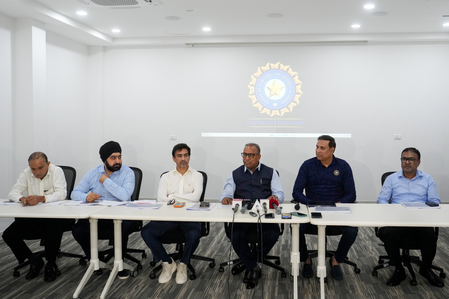
Addressing reporters at the CoE facility here, Laxman detailed the multi-layered diagnostic and recovery setup that connects the BCCI with world-renowned medical specialists, as he pushed back against the criticism of its injury-management protocols.
“The process starts with diagnosing the injury and finishes with a player declared fit after the two RTP (Return To Play) matches we have. Diagnosing, obviously, wherever the player gets injured in whatever environment – if it’s the Indian team, the Indian team physio understands the nature of the injury and then we’ve got experts and specialists with whom we have got a year-long connection.
“Dr Rowan (Schouten) is the one we go as far as stress fracture for the back is concerned. Dr Dinshaw (Pardiwala) is our go-to doctor in Mumbai for shoulder, knee, in fact a lot more injuries. Then we’ve got Dr Kini, who is a foot and ankle specialist. We’ve got Dr (Sudhir) Warrier, who is our hand and wrist specialist. Then we’ve got three doctors… one in England who takes care of the surgeries of the ankle, one doctor in Munich who takes care of the sports hernia, and one doctor in South Africa, provided if we wish to explore that.
“Now, we got three specialists and interventional radiologists, Dr. Muthukumar, Dr. Shrikant, and Dr. Kini, who are the ones who read the scans and tell what is there in the scans. So, that becomes the first part of diagnosing the injury. Once that diagnosis happens, then those players through the Indian team, SSM staff is sent to the CoE,” he said.
Laxman then explained how players transition from physical therapy to match readiness once they arrive at the CoE. “From the time they come here, two things which we do: obviously we clinically examine and assess them. Based on that assessment, we know what is the plan of action for them to recover and go back and join the team. The physio plays a part, and once the player is ready for the next phase, which is your strength and conditioning, then the S&C comes and plays a part.
“Slowly they go to the skill part, and then we build up the load, and then we play two RTP matches before we declare the player fit. Now, what is important, as I mentioned, through the data we have, we know the benchmark of each and every player from the skill and fitness point of view. So until and unless that benchmark is not met, or in fact got better, we don’t release. That’s a benchmark we use to declare a player fit.
“The whole idea is that when he goes back to the Indian team, men and women, or wherever, including the state teams or whatever teams he is participating, he has to be up and running and from the first match, he has been able to perform to the best of his potential.
“Now, it’s an objective way of assessing the player to move from one stage to the next stage and this is where I think it’s very important to understand that the guidelines and the timelines are given based on what you expect. But it’s human body. It is not a machine where the timelines will always be met.
“So, there is a continuous process of understanding how a player is progressing and based on that, the load is increased. So, that is a process from the time they are diagnosed with the injury to the time they leave the COE and declare fit,” he explained.
Turning his attention to workload management for fast bowlers via the AMS (Athlete Management System), Laxman revealed “Again, through this technology, you understand the workload. All this is there on a regular basis on the AMS. Like, the bowling workload for a fast bowler and I think our learning is, the stress injuries or the injuries happen not because a fast bowler is bowling too much. It happens that a fast bowler is not bowling enough.
“I think that’s a critical part for all of us to understand. So there’s a sweet spot we have for each and every fast bowler across the contractor, the targeted and the under-19s and there’s a weekly monitoring of that load. So you give them X number of deliveries which they have to bowl in a week and then through the GPS which the players wear, we get the information whether they have been able to fulfill that or not.
“So there is a lot of emphasis on monitoring the load and I think through technology to various tools, we monitor that. I think remote monitoring is something which is very, very critical and it’s tough. But at the same time, it’s an evolving thing for us in how to remotely monitor a player when he’s not in front of us,” he said.
Laxman also dismissed reports suggesting that contracted Indian players were bypassing official setups to consult private fitness trainers during their injury rehabilitation. “This is news to me and I think there’s a lot of news which is happening. But as I told, the way we do is the Indian team S&C is responsible of keeping a track of the contracted players.
“The S&Cs at the CoE are responsible to keep a track of the targeted and the age-group players. Everything is there on the AMS. Everything, every session of the player is there on the AMS and that is why we use the GPS, where wherever the player is doing, whatever he is doing is documented out there. If you see the men and women team’s trainer, Adrian (le Roux), he is a world class trainer.
“In 2002, I remember he was our first foreign fitness trainer. The quality of him has got no questions around his quality. So, I am sure he knows how to manage the contracted players. Now Nick (Lee) recently joined the Indian women’s team. He is again a very experienced S&C professional.
“Again, all these professionals are not only experienced, but they are knowledgeable and understanding of each and every player in their respective group is there. So, I think the trust and the coordination between the S&C and the players, as far as my knowledge is concerned, is going on. So, if you are saying something else, that’s news to me,” Laxman asserted.
BCCI Secretary Devajit Saikia addressed questions regarding fan access for domestic fixtures held at the state-of-the-art campus, citing government land allocation rules that restrict spectator crowds on site. The CoE is set to host the season-opening Duleep Trophy from August 23.
“There are some restrictions when this land was allocated here that we cannot have crowd in this campus. So that is a government restriction. We cannot violate that. But very close persons of the team members, they can come. But this year, we have increased the number of matches to be telecasted live.
“That way, we are giving the fans to watch their favourite players and favourite teams performing in the field of play. That is one way and we definitely appreciate your suggestions that whether the finals can be hosted in a stadium or not.
“We still have time. We’ll look into that aspect. If required, we’ll do that. But for the time being, what we have done, we have increased the number of matches which were telecasted prior to this year, which is very limited. We have enhanced the numbers now,” he concluded.
–IANS
nr/