
Ahmedabad, July 17 (IANS) A suspected Jaish-e-Mohammed (JeM)-linked module carried out around eight explosive trials at different locations in Gujarat over nearly three years while attempting to perfect improvised explosive device (IED) techniques, the Gujarat Anti-Terrorist Squad (ATS) said on Friday, announcing the arrest of five more suspects in the case and taking the total number of arrests to 13.
The latest arrests came after what the ATS described as intensive interrogation of the eight accused arrested earlier this month in a case registered on July 2 under the Unlawful Activities (Prevention) Act (UAPA) and the Bharatiya Nyaya Sanhita (BNS).
ATS Deputy Inspector General (DIG) Sunil Joshi said the investigation had uncovered what he described as a local or “indigenous” module that had allegedly been radicalised over several years through extremist literature and social media, rather than acting solely on direct instructions from Pakistani handlers.
“Even if everything in the world is going perfectly well, they would still feel that this is their duty, that this obligation has to be carried out,” Joshi said while describing the alleged mindset of the accused.
Referring to the alleged radicalisation process, he added: “This local, what you can call an indigenous module… They have been learning by watching social media. They have not been studying these books just recently; this has been going on for two to three years.”
According to the ATS, Deputy Superintendent of Police (DySP) Harsh Upadhyay received intelligence that some youths from Banaskantha and Patan districts were in contact with Jaish-e-Mohammed operatives in Pakistan.
Investigators alleged they were translating the banned organisation’s radical content into Gujarati, had created a local organisation called ‘Darul Islam Gujarat’ as a representation of JeM in the state and were attempting to recruit like-minded individuals.
Based on the information, a case was registered at the ATS Police Station under Sections 13, 17, 18, 38 and 39 of the UAPA and Sections 61 and 148 of the Bharatiya Nyaya Sanhita.
The initial investigation led to the arrest of eight accused, who were granted 14 days’ police remand. “Searches during the earlier phase of the investigation led to the recovery of a Jaish-e-Mohammed flag, printed copies of books allegedly written by JeM founder Masood Azhar, a printed letter addressed to Azhar and Rs 1.30 lakh, which was intended for terrorist activities,” Joshi told IANS.
The agency also reiterated its earlier claim that around Rs three lakh had been sent by a Pakistani handler identified as Abdullah through a dead-drop near Jalore district in Rajasthan.
Joshi said the money was allegedly used to purchase a vehicle, while the chemicals used in the explosive experiments were bought using the accused’s own savings.
During interrogation, investigators alleged that several accused had been residing at Jamia Abul Hasan Madrasa in Khadiyasan and, since 2023, had been studying methods of making bombs and detonating IEDs using printed copies of the book ‘Akela Mujahid Jihad Kaise Kare (How a Lone Mujahid Should Wage Jihad)’ and similar publications.
The ATS alleged that members circulated the literature among themselves, studied different bomb-making techniques and later began practical experiments.
“The accused purchased potassium nitrate, sulphur and charcoal through online shopping platforms and local markets. They allegedly mixed the chemicals to prepare gunpowder, researched different timer-based and direct ignition systems, studied the quality of wires, experimented with pipes through welding and attempted to improve different explosive mechanisms,” Joshi said.
According to the ATS, between 2023 and February 2026, the group conducted around eight explosive trials at different locations, mainly in isolated fields and riverbeds around Khadiyasan, Mehsana and nearby villages.
The experiments were generally conducted on Fridays or during madrasa holidays when members from different towns could gather.
“They had carried out around eight such experiments over the past two to three years in an attempt to perfect these methods. Practically, they were trying to gain expertise in making explosives,” Joshi told IANS.
He said the explosive mixture was low-grade and comparable to firecracker gunpowder.
“Sometimes it only burned. Sometimes it burned very rapidly without producing a proper explosion. If packed tightly, there could be a slight blast,” he said, adding that the ATS had found no evidence of injuries during the experiments.
The ATS said materials allegedly used in preparing an IED were recovered from accused Mohammad Amin Shera for forensic examination.
Investigators also alleged that Shera had delivered jihad-related speeches and sermons.
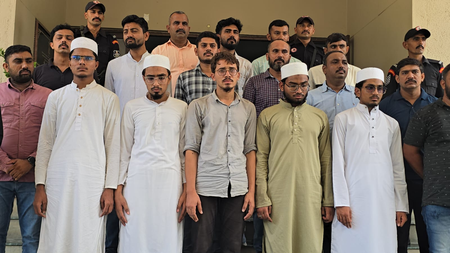
The five newly arrested accused were identified as Bilal Abidbhai Shera, 24, originally from Chatavada in Patan district and staying at Divya Palace near Kathwada GIDC in Ahmedabad while doing mechanical work; Mohammad Ayyub Kadiwala, 22, of Khadiyasan in Siddhpur, who had studied at Darul Uloom Deoband before returning to Jamia Abul Hasan Madrasa; Mohammad Ayyubbhai Sunsara alias Mohammad Khali, 20, residing at Darul Uloom Matliwala Madrasa in Bharuch; Shafi Raees Mukhi alias Shafi Chhapi, 21, from Vadgam in Banaskantha and residing at Jamia Islamia Talimuddin Madrasa in Dabhel; and Mohammad Hasan Hanifbhai Kardiya alias Hasan Haiderpuri, 20, from Patan district and residing at Darul Uloom Matliwala Madrasa in Bharuch.
According to the ATS, Bilal Shera had supplied Mohammad Amin Shera with a pen drive around three years ago containing speeches, videos, and books allegedly related to Masood Azhar.
Investigators said the material was later printed at different locations.
Joshi said the literature was shared through pen drives rather than being purchased online and that investigators were still trying to determine how the original books entered India. “Generally, these books are not available on Amazon or such platforms,” officials confirmed to IANS.
The ATS alleged that Mohammad Ayyub Kadiwala, along with Mohammad Amin Shera, Ahmad Ghaziwala, Zakariya Ghagha and others, assembled at a mosque where they learnt to assemble an IED and successfully conducted an explosive test.
Investigators also alleged that members held three “dawat” gatherings. Clarifying the term, Joshi said it referred to inviting people into the group rather than simply sharing a meal.
According to the ATS, the accused used these meetings to study extremist literature and invite other madrasa students to join jihad. Joshi said all 13 accused identified so far had been arrested.
“As of now, everyone identified is in our detention. If further interrogation or analysis of their mobile phones reveals additional accused, they will also be arrested,” he confirmed.
The DIG said investigators had not found evidence that the five newly arrested accused were directly in contact with Pakistani handlers. “Our investigation has not revealed that they were receiving direct instructions from outside,” he said.
Instead, he alleged they had been inspired by JeM literature for several years before any handler came into contact with the group.
He also said investigators had found no evidence so far of any involvement by the madrasas where the accused had studied or stayed. “So far, we have not found any such role,” he said.
According to Joshi, communication took place through Instagram, WhatsApp and Telegram at different times, while investigators continued to examine digital evidence.
The ATS is also continuing efforts to identify a Kashmiri man whom investigators allege met some of the earlier accused on the instructions of the Pakistani handler and supplied extremist literature.
However, Joshi said “no conclusive identification” had yet been made.
Asked whether investigators had identified any specific planned target, Joshi said the ATS had no documentary evidence indicating where the alleged group intended to strike.
Describing the suspects as “highly radicalised”, Joshi said: “The ATS believes they were still in the process of learning and improving explosive techniques when the investigation disrupted the alleged conspiracy. The investigation is continuing.”
–IANS
mys/dpb