
Washington, July 8 (IANS) India’s leading industry bodies on Wednesday urged the United States Trade Representative (USTR) to drop its proposed 12.5 per cent tariff on Indian imports, arguing that Indian businesses already operate under stringent labour and environmental compliance systems and that broad-based tariffs would raise costs for American manufacturers without helping eliminate forced labour.
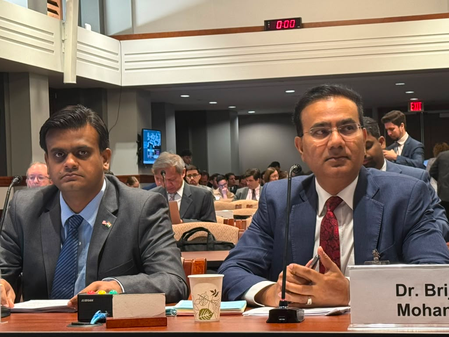
Appearing before a USTR Section 301 hearing, representatives of the Federation of Indian Chambers of Commerce and Industry (FICCI) and the Confederation of Indian Industry (CII) said Indian industry fully supports the objective of eliminating forced labour from global supply chains but disputed the basis for imposing economy-wide tariffs on India.
Presenting FICCI’s case, Poornima Shenoy said Indian businesses had invested heavily in responsible sourcing, supply chain due diligence, traceability and environmental, social and governance (ESG) compliance because “responsible business has become a commercial necessity.”
She argued that the proposed tariff adopted an overly broad approach.
“Our first concern is that the measure adopts a broad-based approach that applies across all sectors and products, irrespective of the individual risk profile in the supply chain,” Shenoy said in her testimony, adding that supply chains differ in governance, sourcing practices and compliance mechanisms. A targeted, evidence-based and risk-based approach, she said, would be more effective than an economy-wide tariff.
Shenoy also said India’s legal and institutional framework already protects labour rights through labour laws, enforcement mechanisms, inspections and judicial remedies. She stressed that most Indian exporters supplying the United States operate within strict compliance ecosystems that include supplier audits, ethical sourcing standards, worker grievance mechanisms, traceability systems and continuous monitoring.
She warned that additional tariffs would increase costs for Indian exporters as well as U.S. manufacturers, retailers and consumers.
“Many U.S. industries rely on long-standing sourcing relationships with Indian suppliers because they deliver products of quality and reliability and ensure full compliance,” she said.
Representing CII, Shuchita Sonalika said that India’s largest industry association, which represents more than 10,500 direct members and over 365,000 enterprises indirectly, also supported the global objective of eliminating forced labour. However, she said the proposed 12.5 per cent additional duty was “not warranted” and would “penalise a compliant industry without advancing the stated policy goal.”
Her statement outlined three principal arguments.
First, she said India has a comprehensive legal and institutional framework prohibiting forced labour, including constitutional protections, the Bonded Labour System (Abolition) Act, modern labour codes, criminal penalties and ratification of the International Labour Organization’s core conventions on forced labour. India also mandates Business Responsibility and Sustainability Reporting for its top 1,000 listed companies, requiring disclosures on human rights, forced labour complaints, and supply chain assessments.
Second, Sonalika argued that Indian companies already operate within rigorous global compliance systems. She cited examples from the aluminium, textile, foundry, forging, and agricultural machinery sectors, saying that exporters follow supplier codes of conduct, ESG frameworks, buyer-mandated compliance, and international labour standards.
She also noted that none of India’s major sources of manufactured goods imports appears on the U.S. Trafficking Victims Protection Reauthorization Act list.
Third, she challenged the USTR’s economic analysis, arguing that the report failed to establish that India’s policy framework burdens U.S. commerce.
During the hearing, committee members asked industry representatives how exempting exports from additional duties would encourage countries under investigation to eliminate unfair labour practices.
Responding on behalf of CII, Sonalika said “compliance and cooperation-based mechanisms would be far more effective than the applications” of tariffs.
She highlighted CII’s work with the International Labour Organisation and the United Nations Development Programme on responsible business practices and said Indian companies already maintain documented codes of conduct, supplier codes and ESG frameworks. She added that India would welcome cooperation with U.S. authorities to further strengthen compliance systems rather than impose punitive trade measures.
Both FICCI and CII assured that the USTR should reconsider the proposed tariffs in light of India’s legal safeguards, existing compliance mechanisms and the importance of resilient U.S.-India supply chains. They urged Washington to pursue cooperation and dialogue instead of broad trade restrictions, arguing that stronger compliance, rather than higher tariffs, offers the most effective path to addressing forced labour concerns.
–IANS
lkj/dan