

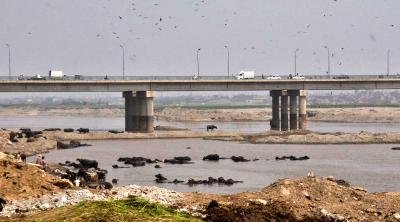
Islamabad, July 8 (IANS) Pakistan is facing an escalating water crisis, with cities such as Lahore and other parts of Punjab province witnessing worsening shortages. However, instead of addressing structural failures and excessive groundwater extraction that has aggravated the water crisis, Islamabad continues to blame India, a report has stated.
According to a Eurasian Times report, Pakistan has one of the most inefficient irrigation systems, with massive water losses caused by seepage and leakage.
Citing the International Water Management Institute’s (IWMI) country assessments (2024–2026 updates), it noted that nearly 95 per cent of Pakistan’s freshwater is used for agriculture, while around 60 per cent of irrigation water is lost due to inefficient canals and field systems.
Pakistan recently organised an international seminar at the Jinnah Convention Centre in Islamabad, titled ‘Indus Waters Treaty: An Instrument of Peace and Regional Stability’.
“The title of this seminar was strategically framed to present the issue as a grave regional security challenge requiring immediate international intervention. This is similar to how Pakistan has long portrayed Kashmir as a ‘nuclear flashpoint’ by linking its resolution to peace and security in South Asia. It has now attempted to employ the same strategy with the Indus Waters Treaty,” the Eurasian Times stated.
The report noted that although Pakistan frequently portrays the Indus Water Treaty (IWT) as a model of successful transboundary river cooperation, its survival since 1960 has largely been possible because India, as the upper riparian state, has consistently exercised “goodwill and generosity”.
“Now imagine if Pakistan had been the upper riparian state. It is difficult to believe that it would not have leveraged its upstream position from the very beginning and used the treaty as an instrument of pressure against India,” it added.
The report highlighted that Pakistan repeatedly violated the spirit of the IWT, by launching wars against India in 1965, 1971, and during the Kargil conflict in 1999. It added that Pakistan also continued to sponsor cross-border terrorism, including the Parliament attack in December 2001, the Mumbai terror attacks in November 2008, the Pulwama attack in February 2019, numerous other terror incidents, and most recently the heinous Pahalgam terrorist attack in April 2025.
“Following the Pahalgam attack, the Government of India placed the treaty in abeyance. India has now explicitly linked the future of the Indus Waters Treaty to Pakistan ending cross-border terrorism, making any future cooperation contingent upon Pakistan’s actions in this regard,” it stated.
According to the report, the 1960 signing of the IWT was accompanied by a major international financing package under which Pakistan received assistance from India (about £62 million) and other donor nations to construct replacement works, including dams, barrages, canals, and storage facilities. However, despite receiving considerable financial assistance, Pakistan failed to build sufficient water storage capacity and has continued to blame India for its water challenges.
–IANS
scor/as