
New Delhi, July 4 (IANS) Pakistan’s contrasting responses to upstream water projects by India and China have raised questions about the consistency of Islamabad’s stance on transboundary water security. If upstream interventions are considered a threat to downstream interests, the same principle should apply regardless of whether the upstream country is India or China, a report has highlighted.
The muted response to Beijing’s upper Indus dam, alongside persistent objections to Indian projects under the Indus Waters Treaty, has strengthened perceptions that Pakistan’s water diplomacy is influenced as much by strategic alignments as by concerns over water security, according to a report in ‘Organiser.’
“The geopolitics of South Asian water security has once again highlighted contrasting responses to upstream river developments. While Pakistan has consistently accused India of violating the spirit of the 1960 Indus Waters Treaty over hydropower projects on the western rivers, its response to a Chinese dam on the upper reaches of the Indus has remained conspicuously restrained,” the report stated.
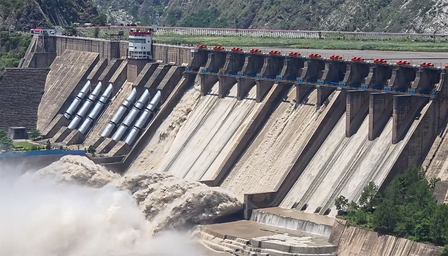
“China has constructed a medium-scale dam on the Sengge Zangpo, the Tibetan name for the upper reaches of the Indus River, near Demchok in western Tibet, close to the Line of Actual Control (LAC) with Ladakh. Reports available for more than a decade indicate that the structure diverts and regulates sections of the river for local hydropower generation while supporting infrastructure expansion in Tibet’s Ngari prefecture,” it added.
The Chinese project located upstream of both India and Pakistan, the report said, could have implications for seasonal water flows further downstream. Despite the strategic consequences, the development has not prompted a sustained diplomatic or political campaign from Pakistan that is often directed at Indian projects on the Indus River system.
“Pakistan has frequently raised objections to Indian run-of-the-river hydropower projects and maintenance works on the Chenab and Jhelum rivers. Islamabad has repeatedly alleged violations of the Indus Waters Treaty, describing such projects as threats to its agriculture and water security. These concerns have been pursued through multiple international mechanisms, including the World Bank and the Permanent Court of Arbitration,” the report detailed.
“In contrast, China’s project on the Sengge Zangpo has attracted little public criticism from Pakistan. There have been no major parliamentary debates, international legal initiatives, or official warnings comparable to those issued against India over similar concerns. The absence of sustained public objections stands out, given Pakistan’s dependence on the Indus River system,” it noted.
According to the report, the differing responses reflect broader geopolitical realities, with China remaining Pakistan’s principal strategic partner.
As Pakistan’s largest supplier of military equipment, a major investor through the China-Pakistan Economic Corridor (CPEC), and a consistent diplomatic supporter in international forums, it said, Beijing occupies a central place in Islamabad’s strategic and economic calculus. Publicly challenging China over its upstream water infrastructure projects could therefore complicate a relationship that serves Pakistan’s interests.
–IANS
scor/ksk/as