
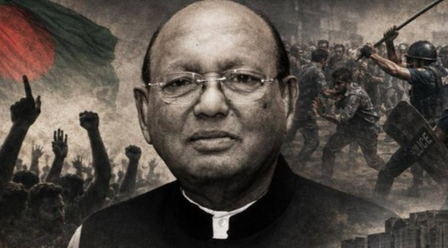
Dhaka, June 3 (IANS) Bangladesh’s Awami League alleged that the funeral of senior party leader Tofail Ahmed was marked by confrontation, detentions, and allegations of deliberate obstruction, despite the authorities’ claim that the country has moved beyond the cycle of political vengeance.
The party said that “what should have been a dignified national farewell” for the veteran 1971 Bangladesh Liberation War organiser and nine-time parliamentarian, who died on June 1, instead descended into confrontation, detentions, and claims of deliberate obstruction.
According to the Awami League, after the funeral prayers for Ahmed in Dhaka’s Dhanmondi, supporters raised slogans, including “Joy Bangla”, following which police moved in and detained several individuals. It added that disturbing videos of baton-wielding officers dispersing mourners were later widely circulated.
“This was not a violent protest. It was the funeral of a man who had spent decades at the centre of Bangladesh’s political life. Yet even grief was treated as a potential threat,” the party stated.
Highlighting that the crackdown was not limited to the capital, the Awami League said that at the deceased leader’s ancestral home in Bhola district, authorities deployed heightened security measures and imposed administrative restrictions aimed at limiting large spontaneous gatherings.
Citing critics, the party argued that the intent was clear: “to prevent ordinary citizens from turning the burial of a beloved local son into a powerful show of collective mourning.”
Condemning the repression, the Awami League questioned the ruling Tarique Rahman-led Bangladesh Nationalist Party (BNP) government, asking whether a nation that polices funerals and fears public grief can truly call itself “civilised” or “new”.
“When a government feels compelled to control the mourning of even its historical adversaries, it reveals not strength, but deep insecurity. True political confidence does not fear tears or slogans at a graveside. It allows citizens to say goodbye without treating the dead as security risks,” the party noted.
The party further said that the episode should serve as a warning to the international community, alleging that in the “so-called ‘New Bangladesh’: basic humanitarian norms surrounding death appear negotiable.”
“If a state cannot extend minimum courtesy to the mortal remains of a veteran national leader, what protections exist for the living who dare to disagree?” it questioned.
The Awami League said that Ahmed’s “disrupted final farewell” forces a deeper reckoning, raising the question of what kind of future Bangladesh is building—“one grounded in dignity and restraint, or one where political vengeance follows a man even into the grave.”
–IANS
scor/rs