
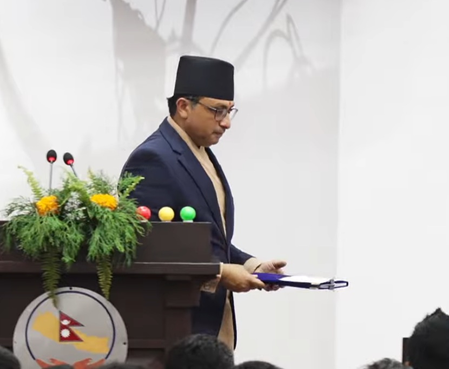
Kathmandu, May 29 (IANS) Nepal’s Finance Minister, Swarnim Wagle, on Friday announced major tax relief measures targeting the middle class, mirroring steps taken by the Indian government in February 2025.
Presenting a budget of NPR 2.124 trillion for the fiscal year 2026-27 at a joint session of Parliament, Minister Wagle said the government has raised the income tax exemption threshold for individuals to NPR 1 million. Currently, individuals earning more than NPR 500,000 annually are required to pay income tax. Nepal’s new fiscal year begins in mid-July.
The government has also reduced the maximum personal income tax rate by 10 percentage points, from 39 per cent to 29 per cent, to ease the tax burden on citizens.
“To support domestic industries, customs duties on 273 types of industrial raw materials have been reduced, ensuring that tariffs on raw materials remain at least one level lower than those on finished goods,” the minister said. “The existing 11-tier customs structure has also been streamlined into seven tiers.”
Minister Wagle said he had undertaken a broad review of tax rates to provide relief to enterprises and businesses, expand the middle class, and make the overall economy more dynamic.
On the investment front, the Nepali government plans to amend the Foreign Investment and Technology Transfer Act to remove the minimum investment threshold for foreign investors. “Foreign investment procedures will be fully digitised, and the One Stop Service Centre will be strengthened to improve the investment climate,” the finance minister said.
Recognising information technology as a key pillar of economic growth, the government plans to develop Nepal into an IT hub by establishing IT parks in major cities, expanding high-speed internet infrastructure, and offering tax incentives for digital service exports.
Minister Wagle also announced measures to allow outward investment for the expansion of the information technology service sector. He said the government would introduce clear legal provisions to enable individuals to work remotely from Nepal for foreign employers and to attract remote work opportunities.
He further announced that the government would establish a fintech marketplace under the supervision of the Nepal Rastra Bank, the central bank.
As artificial intelligence emerges as a major global economic sector, the Nepali government also unveiled an ambitious roadmap to position Nepal for the AI era. The plan includes establishing the country’s first ‘Sovereign AI Compute Centre’ in Kathmandu and increasing investment in AI infrastructure and digital innovation.
Wagle said the government aims to utilise Nepal’s clean hydropower resources to develop high-value AI computing services, arguing that the country’s vast energy potential could become the foundation for AI-driven economic growth.
The budget also introduced measures to promote Nepal’s startup ecosystem. “We will establish the Nepal Enterprise Facility as a platform to integrate startups, small enterprises and medium-sized enterprises into the national enterprise ecosystem,” Wagle said. “The platform will advance, in an integrated manner, policy arrangements related to entrepreneurship, identification of and access to innovative financial instruments, support networks including incubation services, and campaigns promoting domestic enterprises.”
–IANS
scor/as