

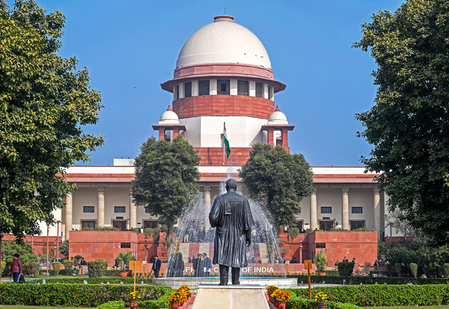
New Delhi, May 26 (IANS) The Supreme Court on Tuesday issued a fresh set of sweeping directions to Rajasthan, Madhya Pradesh, and Uttar Pradesh to curb rampant illegal sand mining in and around the National Chambal Gharial Sanctuary, cautioning that continued environmental degradation and unchecked mining activities pose a serious threat to wildlife habitats, river ecosystems and public infrastructure.
A bench of Justices Vikram Nath and Sandeep Mehta, hearing the suo motu matter concerning illegal sand mining in the Chambal region, directed the three states to strengthen surveillance systems, expedite recruitment of frontline forest personnel, intensify prosecution against organised mining networks, and ensure protection of ecological flows in the Chambal River.
Invoking its powers under Article 142 of the Constitution, the apex court directed the states to complete, “as far as practicable”, recruitment to vacant posts of forest guards and other frontline enforcement personnel within one year.
“The material placed before this Court, the compliance affidavits filed by the respective states and the National Highways Authority of India (NHAI), and the continuing and grave concerns relating to rampant illegal sand mining activities, degradation of protected wildlife habitats, operation of unregistered and unidentified vehicles, inadequacy of enforcement mechanisms and the threat posed to critical public infrastructure in the affected regions” necessitated further directions, the Justice Vikram Nath-led Bench observed.
It also ordered Rajasthan, Madhya Pradesh, and Uttar Pradesh to operationalise CCTV surveillance systems, integrated monitoring mechanisms and control centres in vulnerable regions within six months.
In a significant direction, the apex court ordered stringent action against vehicles involved in illegal mining and transportation activities, including tractors, excavators, dredgers and dumpers operating with fake or tampered registration plates or without valid registration particulars.
It directed authorities to initiate criminal prosecution not only against drivers but also against owners, financiers, contractors and others connected with organised illegal mining operations.
“The concerned states shall ensure that all FIRs and criminal proceedings relating to illegal mining and transportation activities are effectively and comprehensively investigated not merely against the drivers of the vehicles involved, but also against the owners, financiers, operators, contractors and all other persons involved in organising, facilitating, financing or otherwise benefiting from such illegal mining operations,” the bench said.
Taking note of increasing attacks on forest personnel engaged in anti-mining operations, the apex court also directed the three states to examine the need for granting statutory protection to forest guards and frontline enforcement personnel for bona fide actions performed during official duties.
It further directed the NHAI to install high-resolution night-vision CCTV cameras on the National Highway-44 bridge near the Morena-Dholpur border, covering vulnerable stretches of the Chambal riverbed where illegal excavation activities have been reported. The surveillance feed is to be shared with police and forest authorities of Rajasthan and Madhya Pradesh to facilitate coordinated enforcement action.
The apex court additionally ordered immediate steps to prevent dumping of debris and waste into the Chambal River from bridges and adjoining infrastructure, directing the NHAI to install tamper-proof fencing and protective mesh around vulnerable locations.
In another significant direction, the Justice Vikram Nath-led Bench asked the three states to examine the feasibility of creating employment schemes, skill development programmes and livelihood initiatives for local youth and economically vulnerable communities residing in regions affected by illegal mining.
The apex court also directed the states to explore involving local communities in conservation, eco-tourism, afforestation and environmental protection activities connected with the National Chambal Gharial Sanctuary.
Expressing concern over ecological flows in the Chambal River, the top court impleaded the Union Ministry of Jal Shakti and the Central Water Commission as party respondents and directed them, along with the three states, to file affidavits detailing measures being taken to preserve and augment environmental flows in the river and its tributaries.
The bench also observed that any proposal for de-notification of a wildlife sanctuary would require prior approval of the Supreme Court.
In its order, the top also took note of an intervention application filed by the Madhya Pradesh Forest Employees Association, through advocates Rohit Kumar and Akanksha Singh, highlighting the hazardous conditions faced by forest guards and other frontline personnel engaged in anti-mining and wildlife protection duties.
The association submitted that despite several deaths and fatal injuries suffered by forest personnel while discharging official duties, there exists no comprehensive and uniform policy governing compensation, insurance coverage, ex gratia payments and compassionate appointments.
Issuing notice on the application, the Supreme Court directed Madhya Pradesh, Rajasthan and Uttar Pradesh governments to place on record details of existing welfare policies and measures proposed for strengthening protection and welfare mechanisms for frontline forest staff.
The matter has been listed for further hearing on July 22.
Meanwhile, shortly after dictating the detailed order, the bench took on record a media report highlighting that illegal sand mining and transportation activities were continuing unabated despite earlier directions of the top court.
The news report referred to “numerous instances of unregistered and unnumbered vehicles carrying sand” in villages of Madhya Pradesh’s Morena district.
Taking serious note of the newspaper report placed before it by amicus curiae, senior advocate Nikhil Goel, the apex court directed Additional Solicitor General S. V. Raju, appearing for Madhya Pradesh, to file an urgent response.
“Mr S.V. Raju, learned ASG representing the State of Madhya Pradesh, shall file urgent response to the observations noted in the aforesaid news report,” it ordered while posting the matter on Friday for further consideration of the fresh allegations.
The latest directions come in continuation of the apex court’s earlier order, where it had described rampant illegal mining in the Chambal sanctuary as a reflection of “systemic and institutional failure” on the part of the state authorities. The Supreme Court had observed that illegal mining activities had caused “severe disruption of riverine and ecological systems” and posed a direct threat to critically endangered gharials and other aquatic wildlife.
–IANS
pds/vd