
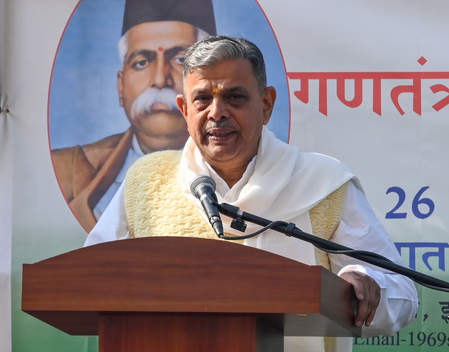
Stanford, April 18 (IANS) The Rashtriya Swayamsevak Sangh has asserted that the success of democracy in India is rooted in its civilisational and cultural ethos, with its General Secretary Dattatreya Hosabale arguing that democratic values are embedded in what he described as the country’s Hindu philosophical tradition.
In an interview marking 100 years of the RSS, Hosabale told IANS that democracy in India should not be viewed merely as a system of governance but as a deeper societal mindset shaped by cultural values.
“The system of democracy may change from time to time,” he said, noting that different countries follow varied institutional models.
“Britain has something, Germany has another thing, US has one more thing. India has experimented something,” he added.
However, Hosabale stressed that the durability of democracy depends not on institutions alone but on the underlying outlook of society.
“Whether democratic mindset is there… the Hindu philosophy has this democratic outlook and democratic mindset,” he said.
He described this as “spiritual democracy”, arguing that India’s civilisational traditions have long embraced diversity while maintaining a sense of unity.
“There are so many… in Bharat, but we are all one,” he said, pointing to coexistence across traditions as a defining feature of Indian society.
Hosabale argued that this cultural foundation explains why democracy has endured in India despite political and social challenges.
“India’s mind is basically democratic,” he said.
He contrasted India’s experience with that of neighbouring countries that emerged from the same historical context but have struggled to sustain democratic systems.
“You see these countries around… those who broke away in 1947, do they have democracy in their country?” he said.
He added that India’s democratic resilience was evident even during periods of political strain.
“Once it was tried to be tinkered with, it did not survive… people threw out the regime,” he said, referring to a period when democratic norms were challenged.
Hosabale linked this resilience to what he described as a deeply ingrained cultural commitment to pluralism and participation.
He argued that democracy in India is not limited to electoral processes or institutional frameworks but extends to social behaviour and everyday interactions.
“Democratic living is not just because of governance, it is a way of life,” he said.
The RSS leader also suggested that India’s democratic experience offers lessons for the wider world, particularly at a time when several countries are grappling with political polarisation and institutional challenges.
“It is a mindset. It is an approach,” he said, emphasising that democratic values must be cultivated within society to sustain political systems.
At the same time, Hosabale acknowledged that governance structures differ across nations and evolve over time, but maintained that cultural foundations play a decisive role in shaping outcomes.
His remarks come amid ongoing debates in India and abroad over the nature of democracy, secularism and the role of cultural identity in governance.
Hosabale’s comments also intersect with broader discussions about the evolution of democratic institutions in India, including electoral reforms, governance models and the role of civil society.
In the same interview, he emphasised the importance of political awareness and civic education, arguing that an informed citizenry is essential for the functioning of democracy.
“People require the political education for thinking the right thing,” he said, linking democratic participation to societal responsibility.
He also called for political parties to prioritise national interest over partisan considerations, reinforcing the idea that democracy must be guided by a broader commitment to unity.
“Nation first, then other things,” he said.
Hosabale reiterated that all citizens must enjoy equal rights irrespective of religion or background, while also emphasising the importance of national loyalty.
“All Indians are having equal rights. Nobody is a second-class citizen,” he said.
At a philosophical level, he framed democracy as part of a larger civilisational vision that integrates diversity with unity and balances individual freedom with collective responsibility.
He suggested that this approach could help address contemporary global challenges, including social fragmentation and ideological conflict.
–IANS
lkj/rs