
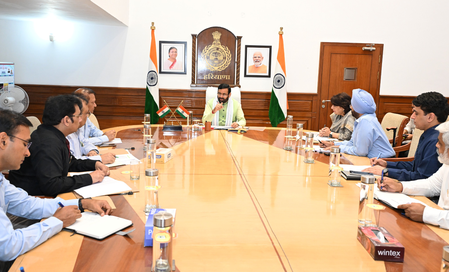
Chandigarh, March 30 (IANS) Haryana Chief Minister Nayab Singh Saini, while chairing a key meeting with officers of the Urban Local Bodies Department here on Monday, directed them to identify suitable locations for installing water harvesting systems across the state.
He said waterlogging issues occur at several places during the rainy season, and therefore, concrete arrangements should be made in advance to address them.
During the meeting, he reviewed in detail the pre-monsoon preparations, including drain cleaning, water drainage systems, and sanitation arrangements, and issued necessary directions to the officers.
He directed that areas with drainage issues be identified and that alternative solutions be adopted. He particularly emphasised the option of installing water-harvesting systems at such locations to conserve rainwater and significantly reduce waterlogging.
The Chief Minister further directed the officers to prepare comprehensive, up-to-date data on water harvesting. This should include details of locations where such systems are already installed, how many are functioning properly, and where new installations are required.
He said these systems should be effectively implemented across all government departments, and that where they have not yet been installed, they should be set up on a priority basis, especially in waterlogging-prone areas.
The Chief Minister also discussed further improving the state’s sanitation system. The officers apprised the Chief Minister that modern technology, particularly the implementation of a radio frequency identification (RFID)-based system for door-to-door garbage collection, is being used to strengthen sanitation management, leading to improved monitoring and transparency. Continuous efforts are being made in this direction.
The Chief Minister also reviewed the GPS-based waste collection system and directed officials to ensure its effective monitoring. The officers informed that RFID technology is being used in this system to make the waste collection process more organised and transparent.
Providing details of steps taken to strengthen monitoring of sweeping machines, officials stated that four cameras will be installed on each machine, one facing forward, one on top, one below, and one at the rear.
It was further stated that if the sensor installed underneath the machine is found to be non-functional during cleaning operations, payment to the concerned agency will not be made.
Additionally, agencies will now be required to submit video footage of their work along with their monthly bills for verification, if required.
A penalty provision of Rs 1,250 per hour has also been introduced to ensure accountability of agencies and prevent negligence in work.
–IANS
vg/dan