

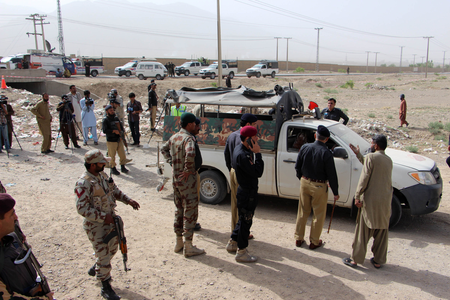
Islamabad, March 30 (IANS) Pakistan’s civilian and military leadership should be pressed to confront the consequences of decades of strategic tolerance and nurturing towards terrorism operating from its soil — an approach that has made the country the most terror-affected in the world, according to a new report.
The Pakistani people, who have borne the greatest cost of this policy in blood, deserve leadership that places their security above entrenched strategic doctrines.
“For decades, Pakistan’s role as a haven for armed militant groups has been treated largely as South Asia’s problem — a festering wound in the India-Pakistan relationship, a complication in the Afghanistan files, and a talking point in diplomatic communiques that go nowhere. The assumption, implicit in how Western capitals have long approached the issue, is that whatever happens in the badlands of Khyber Pakhtunkhwa or the madrassas of Lahore is essentially a regional matter, best left to the region to sort out,” a report in ‘One World Outlook’ stated.
Citing new findings from the US Congressional Research Service (CRS), released on March 25, the report said this clearly debunks comfortable fiction embraced by the West.
According to the report, the CRS, a nonpartisan research arm of the United States Congress, has identified around 15 armed militant organisations operating from Pakistani soil, with 12 designated as Foreign Terrorist Organisations under US law.
“They range from Al-Qaeda core — founded in Pakistan in 1988 and still maintaining alliances with other groups there — to the Islamic State-Khorasan Province, with an estimated 4,000 to 6,000 fighters operating across the Afghanistan-Pakistan border region. They include groups focused on destabilising India and Kashmir, dismantling the Pakistani state itself, targeting Iran’s ethnic Baloch regions, and waging sectarian violence against Shia Muslims,” it detailed.
“Taken together, they constitute not a single ideological project but an entire ecosystem of militant infrastructure — one that has been nurtured, tolerated, or inadequately confronted for decades,” it added.
Highlighting the central paradox of the CRS findings, the report said Pakistan is both a country battered by terrorism and one that has enabled the conditions for these terrorist groups to survive.
“The two facts are not unrelated. For years, Islamabad calculated that tolerating certain militant groups — particularly those oriented toward India and Afghanistan — served its strategic interests. It believed it could control the ecosystem. It cannot. The same networks, the same financing channels, and the same ideological infrastructure that sustain groups like Lashkar-e-Taiba and Jaish-e-Mohammed also sustain the groups now killing Pakistani security forces and their families by the thousands,” it noted.
The report further stressed that the question is not whether Pakistan has been affected by terrorism — it clearly has — but whether it is taking comprehensive steps to dismantle the infrastructure that enables it.
–IANS
scor/sd/