
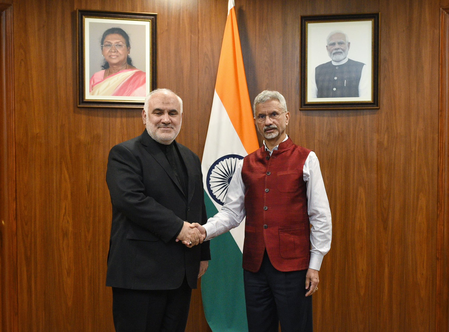
New Delhi, March 24 (IANS) External Affairs Minister (EAM) S Jaishankar met the Iranian Ambassador in New Delhi on Tuesday with discussions focused on the ongoing conflict in West Asia.
“Met with Iran’s Ambassador in India, Dr. Mohammad Fathali this afternoon. Discussed the conflict in West Asia. Appreciate the support provided to Indians in Iran in these challenging times,” EAM Jaishankar wrote on X after the meeting.
Last week, Prime Minister Narendra Modi spoke with Iranian President Masoud Pezeshkian, discussing regional developments and bilateral cooperation.
Prime Minister Modi had also conveyed his warm greetings to President Pezeshkian on the auspicious occasions of Eid and Nowruz. During the discussion, both leaders had expressed their shared hope that this festive season would usher in a period of peace, stability, and prosperity for the West Asian region.
During the call, PM Modi condemned the recent attacks on critical infrastructure in the region, noting that such actions threaten regional stability and disrupt vital global supply chains. The Prime Minister reiterated the critical importance of safeguarding the freedom of navigation and ensuring that international shipping lanes remain open and secure. PM Modi had also expressed his sincere appreciation for Iran’s continued support in ensuring the safety and security of Indian nationals residing in the country.
“Spoke with President Dr. Masoud Pezeshkian and conveyed Eid and Nowruz greetings. We expressed hope that this festive season brings peace, stability and prosperity to West Asia. Condemned attacks on critical infrastructure in the region, which threaten regional stability and disrupt global supply chains. Reiterated the importance of safeguarding freedom of navigation and ensuring that shipping lanes remain open and secure. Appreciated Iran’s continued support for the safety and security of Indian nationals in Iran,” PM Modi had posted on X after his call with the Iranian President.
On Tuesday, Prime Minister Modi addressed the Rajya Sabha, presenting the government’s position on the situation arising from the ongoing conflict in West Asia. Noting that the war, which has been raging for over three weeks, has precipitated a severe global energy crisis with deeply worrying implications for India, PM Modi pointed out that the conflict is disrupting India’s trade routes and affecting the routine supply of essential commodities such as petrol, diesel, gas, and fertilizers.
Detailing India’s vigorous diplomatic outreach since the outbreak of hostilities, Prime Minister Modi informed the House that he has personally conducted two rounds of telephonic conversations with heads of state of most West Asian nations and that India remains in continuous contact with all Gulf countries, as well as with Iran, Israel, and the United States. The objective, he stated, is the restoration of peace in the region through dialogue and diplomacy, and discussions on de-escalation and reopening of the Strait of Hormuz have been specifically taken up.
Emphasising India’s firm stance, PM Modi declared that attacks on commercial vessels and obstruction of international waterways like the Strait of Hormuz are unacceptable, and that India has categorically opposed all attacks on civilians, civil infrastructure, and energy and transport-related infrastructure.
“Any threat to human life in this war is against the interests of humanity, and therefore India’s sustained endeavour is to encourage all parties towards a peaceful resolution at the earliest,” remarked PM Modi on Tuesday.
–IANS
/as