

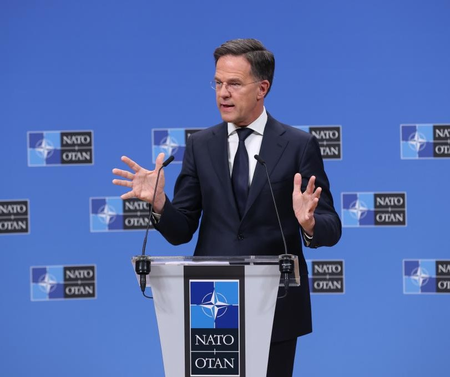
Washington, March 23 (IANS) NATO Secretary General Mark Rutte backed US actions against Iran, warning that Tehran is “very close” to developing missile capabilities that could threaten Europe, even as NATO assessed reports of a long-range strike on a US-UK base in the Indian Ocean.
Speaking on CBS News’ “Face the Nation,” Rutte said NATO could not yet confirm claims that Iran had fired missiles at Diego Garcia, but stressed the implications if verified.
“We cannot confirm that at the moment, so we’re looking into that,” he said. “But if this would be true, it is the more evidence that what the President is doing here… is crucial.”
He added that Iran was nearing the ability to strike major European cities. “What we know for sure is that they are very close to having that capability,” he said, referring to the potential range of Iranian missiles.
Rutte warned that a combination of nuclear and missile capabilities in Iran would pose a global danger. “If Iran would have the nuclear capability, including, together with the missile capability, it will be a direct threat, an existential threat, to Israel, to the region, to Europe, to the stability in the world,” he said.
The NATO chief endorsed US efforts to degrade Iran’s military capabilities, arguing that delay could prove costly. Drawing a parallel with North Korea, he said, “If we negotiate for too long, you might pass the moment where you can still get this thing done.”
His remarks came amid tensions within the alliance after President Donald Trump criticised NATO allies for not doing enough to support US operations, including securing shipping routes through the Strait of Hormuz.
Rutte acknowledged the frustration but said allied coordination was now underway. He revealed that 22 countries — including NATO members and partners such as Japan, South Korea, Australia, and Gulf states — had joined an initiative to ensure safe navigation in the Strait.
“These three questions are now worked through to answer the president’s call, to make sure that we secure the free sailing through the Strait of Hormuz,” he said, referring to planning on “what do we need? When do we need it? And where do we need it?”
He noted that operational timelines remained under discussion, with military planners working on deployment details. “One of the key questions is… the when question,” he said.
Responding to concerns that US pressure could strain NATO unity, Rutte emphasised that the alliance had historically come together during crises. He cited increased defence spending commitments agreed under Trump’s leadership and ongoing cooperation on Ukraine.
“I understand the president’s frustration that it takes some time,” he said, adding that allies had needed time to prepare due to the secrecy surrounding initial US actions.
On Ukraine, Rutte defended US diplomacy despite criticism over easing restrictions on Russian oil exports. He said Washington was balancing multiple priorities while pushing for a negotiated settlement.
“He has to balance all these different interests,” Rutte said. “His effort to bring the war in Ukraine to a successful end is crucial.”
–IANS
lkj/rs