

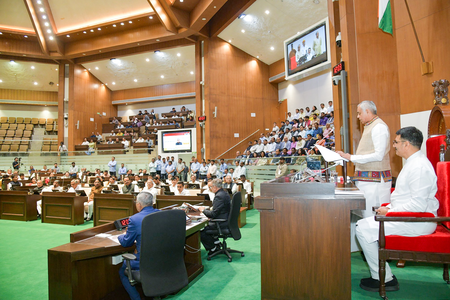
Gandhinagar, Feb 17 (IANS) The Gujarat Legislative Assembly on Tuesday unanimously passed the Gujarat Shops and Establishments (Regulation of Employment and Conditions of Service) (Amendment) Bill, 2026, raising the threshold for the law’s applicability and revising provisions related to working hours and overtime.
Presenting the Bill in the House, Labour and Employment Minister Kunvarji Bavaliya said the amendments were introduced in view of changing economic and social conditions and the need to balance the interests of workers, traders, employers, and the wider public.
Under the revised provisions, the Act will now apply to shops and establishments employing 20 or more workers, instead of the earlier threshold of 10. Establishments employing fewer than 20 workers will not be required to register under the Act, but must provide online intimation.
The minister said this change would ease compliance for small traders and start-ups. The amendment also increases the daily working hours limit from nine to 10 hours.
In addition, the limit for continuous work without a break has been extended from 5 to 6 hours.
The maximum overtime limit has been raised from 125 to 144 hours per quarter. Bavaliya told the Assembly that extending permissible working hours would enhance customer convenience and help accelerate economic activity.
“To give impetus to economic activity and contribute to the country’s economic development, the daily working hours limit has been increased from nine hours to 10 hours,” he said.
Referring to the increase in overtime limits, he added that higher productivity would benefit establishments and improve workers’ economic well-being.
The Bill also retains and strengthens provisions concerning women’s employment.
The minister said women workers may be permitted to work between 9 p.m. and 6 a.m., provided they consent, and the establishment ensures adequate safeguards.
These include restrooms, crèche facilities, separate toilets, protection of dignity and safety, safeguards against sexual harassment, and transport arrangements between the workplace and residence.
“The State Government has made complete provisions in the Act to maintain the dignity, security, and safety of women at the workplace,” Bavaliya said, adding that expanding employment opportunities would enable women to participate more fully in economic activity.
He stated that the amendments were aligned with the policy of “Minimum Government and Maximum Governance” articulated by Narendra Modi and with the broader vision of Viksit Bharat@2047.
–IANS
mys/dan