
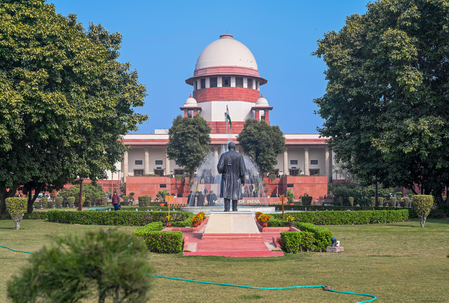
New Delhi, Feb 17 (IANS) The Supreme Court on Tuesday declined to entertain a plea seeking the framing of stringent guidelines to regulate statements and remarks made by constitutional functionaries that do not comport with constitutional morality.
A Bench headed by Chief Justice of India (CJI) Surya Kant said the issue raised was serious, but the petition, in its present form, appeared to target particular individuals.
The plea referred to remarks attributed to Assam Chief Minister Himanta Biswa Sarma, Uttarakhand Chief Minister Pushkar Singh Dhami, Uttar Pradesh Chief Minister Yogi Adityanath, BJP leader Nitesh Rane, and National Security Adviser Ajit Doval, among others, and claimed that nearly 30 troubling public statements have been identified during research.
During the hearing, senior advocate Kapil Sibal, appearing for the petitioners, a group of former civil servants and academics, submitted that the matter required urgent judicial intervention. “We need to do something. Only your lordships can do something. This is becoming very toxic. This petition is not qua any individual,” he argued.
However, the CJI-led Bench observed that the petition had “chosen some individuals selectively, conveniently ignoring others”.
“This is not acceptable; they should be fair,” it remarked, adding that the apex court could not entertain a plea that created an impression of being directed against a particular party or individual.
When Sibal clarified that no specific relief was being sought against CM Sarma and undertook to delete references to him, the CJI Kant-led Bench suggested that the present petition be withdrawn and a fresh plea be filed focusing solely on constitutional principles. “Let the petitioners not create an impression that they are against a particular party or individual,” the top court said.
The bench, also comprising Justices B.V. Nagarathna and Joymalya Bagchi, stressed that political parties must foster fraternity and adhere to constitutional morality.
“Political leaders must ultimately foster fraternity in the country,” it observed, adding that “there should be restraint from all sides”.
The CJI-led Bench also raised a broader concern, questioning whether guidelines, even if framed, would be complied with.
“Before the speech, comes the thought. How can we control the thought?” it asked.
In response, Sibal said that while thoughts cannot be regulated, consequences can be attached to actions, referring to the example of the Vishakha guidelines, which operated until the enactment of the anti-sexual harassment law.
Sibal flagged that certain speeches made before the declaration of the Model Code of Conduct (MCC) continue to circulate online even after elections are notified, and the Election Commission of India (ECI) is often unable to act, as the statements predate the formal announcement of polls.
The senior counsel urged the apex court to consider laying down guidelines for media and online platforms in such situations.
The CJI Surya Kant-led Bench acknowledged that the petitioners were “eminent persons” and that the top court respected the seriousness of the issue raised by them.
“We are inclined to entertain the petition. We are eagerly waiting that somebody will come before us objectively and with impartiality,” the CJI said, while noting that the present petition was “casually drafted”.
The Supreme Court adjourned the matter for two weeks to enable the filing of a modified petition. Sibal assured the bench that a revised plea, without naming any individual and applicable to all political parties, would be filed within a week.
The writ petition, filed under Article 32 of the Constitution through advocate Fuzail Ahmad Ayyubi, contended that repeated discriminatory and derogatory utterances by holders of public office undermine the core values of the Constitution.
Recalling the Constituent Assembly Debates, the petition referred to Acharya J.B. Kripalani’s warning that the principles enshrined in the Preamble were “not merely legal, constitutional and formal principles, but moral principles” which must be lived in political, administrative and public life.
“More than seven decades later, we find ourselves in a political climate where the preambular principles remain in the text, but actions of administrators and constitutional functionaries often betray their intent,” the plea said, adding that “living the principles, as Acharya Kripalani would have asked for, has been lost both in thought and practice”.
The petition alleged that this failure to adhere to constitutional morality has resulted in a series of troubling public statements by constitutional authorities and senior public officials across the country in recent years.
While acknowledging that political actors may subscribe to different ideologies, the petition asserted that constitutional functionaries and holders of public office are bound by the Constitution to ensure fairness in action and restraint in speech.
“Constitutional functionaries, holders of public office, and officials of the government are bound by the Constitution to ensure fairness in action. This would also mean that statements which are discriminatory or derogatory in nature, even if not amounting to hate speech, should be impermissible to be uttered by such persons,” it added.
Clarifying the scope of the relief sought, the petition stressed that it does not seek to curtail free speech or demand penal action for hate speech, which is governed by existing law.
“The present petition does not seek to limit free speech or seek punishments for hate speech,” it said, adding that the limited prayer is for the apex court to evolve guidelines, either through judicial examination or a dialogic process, to ensure that public officials adhere to constitutional morality in their conduct and public discourse.
–IANS
pds/vd