
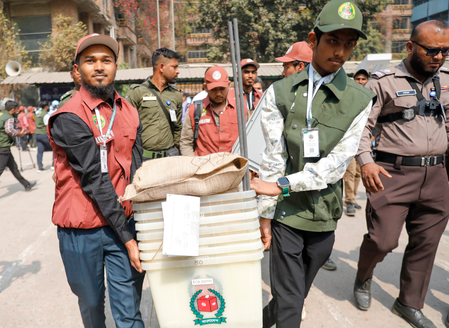
New Delhi, Feb 13 (IANS) The Bangladesh election result has been welcomed by the country’s media as a verdict against fundamentalism and gender inequality, where an alliance led by a more tolerant party won the trust of an overwhelming majority of the 59 per cent of the country’s 12.8 crore electors who exercised their franchise on Thursday.
“BNP clocks landslide victory as Jamaat’s religion card fails,” said Bangladesh’s The Business Standard, while the weekly Blitz termed it “A silent revolt against extremism and pro-Pakistan politics: BNP wins landslide in general elections”.
And in a quick assessment of the results on Friday, the Dhaka Tribune found: “Seven women candidates elected to parliament.”
But if that indeed is the total number of women in a 300-member Parliament, then Bangladesh may need to work more on gender equality. The report said that of these, six were from the Bangladesh Nationalist Party (BNP), and one was an independent candidate.
In “A quick interpretation of BNP’s landslide victory”, The Business Standard identified several points that made the country’s 13th national election stand out.
“Through this election, the voters have proved that they are religious, but they will not allow theological extremism, and they rightly opted for a pluralistic and moderate governance system,” it observed.
Incidentally, Thursday’s poll was preceded by elections in many of the country’s universities where the student organisation affiliated to the Bangladesh Jamaat-e-Islami had won decisively. The results led to an anticipation that the conservative, pro-Pakistan party held an edge over some five crore youth that comprised some 12.8 crore voters in Bangladesh.
“The election results also reflect a strong showing for the rise of women’s power. More than half the voters are women, and they did not like being told they are not good at leading a political platform. They did not like the idea of being labelled as people of moral decay if they came out to the workplace. The male voters were also repulsed at such arcane thinking of a political party vying to lead a country,” the newspaper further observed.
This is the first election in decades that both the Begums, who largely dominated the country’s political space, were absent.
Begum Khalida Zia, who led the BNP after the passing of her husband, and founder of the party, General Ziaur Rahman, died in late December. Her political nemesis, Begum Sheikh Hasina, is currently in exile, with a death sentence handed down since the fall of her Awami League government in August 2024. Hasina leads the party founded by her father, Sheikh Mujibur Rahman, widely known as the chief architect of Bangladesh.
Meanwhile, “On February 12, 2026, Bangladesh chose equilibrium over extremism, democracy over doctrinaire politics, and sovereignty over subtle subservience,” observed the Blitz.
“The lesson is larger than party lines. A nation that fought for linguistic and political freedom will not casually surrender it to ideological nostalgia or external choreography. The electorate has spoken in the firm language of ballots rather than barricades,” it added.
“If BNP remembers that its victory was less about triumph and more about trust, Bangladesh may indeed enter a new era – one defined not by tilts toward distant capitals but by confidence at home,” it further said.
Meanwhile, after much speculation and number crunching across a wide section following the general election, the country’s media on Friday quoted the Election Commission putting Thursday’s turnout in the 13th parliamentary election and referendum at 59.44 per cent.
The mandate is in, now it is upto the BNP and its leader, Tarique Rahman, to live the dream of a vast majority of its citizens.
–IANS
jb/vd