
Dhaka, Feb 12 (IANS) As Bangladesh votes in its 13th National Parliament election, two voter blocs are increasingly being viewed as decisive forces in determining the political outcome — Generation Z and women, according to a media report.
Combined, these groups form a numerical majority of the electorate and are emerging as an independent voting force capable of reshaping conventional party calculations and electoral strategies.
With over 40 million voters between the ages of 18 and 29 and more than 62 million registered female voters, political observers believe that the results of the election may depend less on traditional party machinery and more on generational aspirations and gender-driven voting trends, according to a report published in a leading Bangladeshi daily, The Dhaka Tribune.
Analysts argue that the choices made by these two segments could influence not only which party forms the next government but also the broader direction of Bangladesh’s evolving democratic framework.
Data released by the Election Commission indicates that Bangladesh currently has nearly 127.7 million registered voters. Among them, about 50 million voters fall within the 18-35 age bracket, while over 62 million registered voters are women, bringing the female electorate close to parity with male voters. Nearly 10 million citizens will participate in the election for the first time, further highlighting the expanding influence of new and younger voters, the report said.
Within this demographic structure, approximately 40 million voters belong to the 18-29 age group, while around 26.7 million women voters are between 18 and 37 years old, it added.
These figures indicate that younger voters and women together form a formidable electoral base that could influence outcomes, particularly in constituencies where contests are expected to be close.
Political parties have taken note of this shift in voter composition. Many candidates privately acknowledge that predicting electoral success has become increasingly difficult without understanding the political leanings of women and Gen-Z voters.
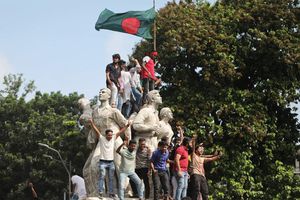
The same youth demographic that played a major role during the 2024 protests is now participating in what is widely seen as the first major “post-movement election”.
Analysts describe this moment as a transition from street-level activism to formal institutional participation.
While Gen-Z voters are being seen as drivers of generational transformation, women voters are being described as catalysts for structural change.
With more than 62 million female voters, their electoral significance is undeniable. What appears to be evolving during this election cycle is not just their numerical strength but also their growing independence in political decision-making, according to The Dhaka Tribune Report. However, according to the Election Commission’s data, women are widely underrepresented.
Women account for just around four per cent of candidates in the upcoming national polls, exposing entrenched gender barriers in a political landscape where women form half the population but barely figure on the ballot.
Several women candidates across constituencies have reported organised cyberbullying, character assassination, sexual harassment and threats, both online and on the ground, aimed at intimidating them and discouraging their campaigns, according to local media reports.
Across grassroots constituencies, candidates are increasingly viewing women voters, particularly those belonging to working-class backgrounds, as a decisive swing constituency. Major political parties, including the BNP, radical Islamist Jamaat-e-Islami, and the National Citizen Party (NCP), have incorporated women-centric commitments in their manifestos in an attempt to appeal to this influential voter segment.
The BNP has pledged to introduce initiatives such as “family cards” aimed at supporting women, free education for women up to the postgraduate level, the establishment of women’s assistance cells, day-care centres, breastfeeding facilities, and expanded entrepreneurship support programs.
Senior BNP leaders have consistently highlighted women-related issues at public meetings, while relatives of prominent party leaders have engaged women and youth audiences through seminars and outreach forums.
Additionally, after making several “misogynist” statements, Jamaat-e-Islami has tried to cover up its image by proposing the creation of a national women’s protection task force and promising to ensure safety and dignified livelihood opportunities for women both domestically and overseas.
Meanwhile, the NCP has suggested conducting direct elections for women candidates across 100 reserved seats in the lower house.
Despite these pledges, questions have been raised regarding the depth and feasibility of these commitments.
Janit Ara Haque, coordinator of the advocacy group We Can, expressed scepticism about whether these manifestos offer meaningful policy innovations for women voters, according to The Dhaka Tribune.
“Women voters have always been decisive,” she said, “but these manifestos lack serious research on what women need and how those plans will be implemented.”
She added that working women, especially those not firmly aligned with traditional ideological bases, could play a crucial role in influencing electoral outcomes.
Women’s political participation is also being reflected through online activism. Digital campaigns encouraging women to “answer misogyny with the ballot” have gained visibility across social media platforms.
Following controversial remarks reportedly linked to Jamaat Ameer Shafiqur Rahman, eleven women’s organisations submitted a memorandum to the Election Commission demanding the cancellation of his candidacy.
Beyond conventional party competition, analysts are describing this election as a pivotal moment in Bangladesh’s democratic evolution.
The election is being conducted without the participation of the Awami League, without the oversight of a traditional caretaker government, and under an interim authority that has promised transparency.
If Gen-Z voters carry forward the “reformist enthusiasm” witnessed during the 2024 protests and if women voters exercise independent electoral judgment in substantial numbers, Bangladesh’s political map could undergo a significant transformation, the media report said.
–IANS
sd/