
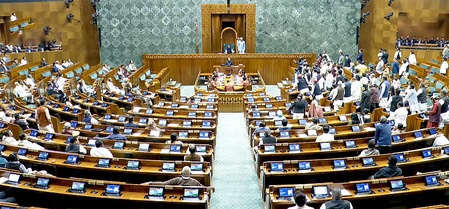
New Delhi, Feb 9 (IANS) Since the beginning of the Budget Session of Parliament on January 28, till February 6, Lok Sabha achieved a productivity level of 20 per cent, and the Rajya Sabha, about 89 per cent, according to a study.
While the Upper House functioned for a total of 31.9 hours during that period, the Lower House could clock only 7.7 hours, as per a report by PRS Legislative Research.
Rajya Sabha spent 23.1 hours on non-legislation, i.e., actions or decisions not made through formal legislative processes, and Lok Sabha clocked only 2.9, it said.
In other matters, while Rajya Sabha devoted 5.9 hours to questions, 0.7 in legislation, and 2.1 in other business, the Lower House of Parliament could find time for such work for 2.3, zero, and 1.1 hours, respectively, the report added.
The only business the Lok Sabha devoted more time to was financial, with 1.4 hours against zero in the Upper House. This stems from the Lok Sabha’s exclusive power to introduce Money Bills, in which the Rajya Sabha’s role is limited to reviewing and making recommendations, which the Lower House can accept or reject.
The overall figures reflect the state of affairs in the seat of democracy, especially the Lok Sabha, where Leader of the Opposition Rahul Gandhi has been insisting on being allowed to refer to a yet-unpublished, unsubstantiated work, purportedly the memoirs of a former Chief of the Indian Army.
The effect has been on Lok Sabha business, where aggressive members from the Opposition benches are seen rushing to the well of the House and even to the Prime Minister’s seat, shouting loud slogans, leading to adjournments.
The Lower House of Parliament witnessed an uproar last week with the Opposition repeatedly disrupting proceedings over the India-United States bilateral trade agreement, which they claimed lacked transparency.
Meanwhile, references to Rahul Gandhi’s continued coverage of former Army Chief General M.M. Naravane’s unpublished memoir on the 2020 Galwan clash with China continued till Monday.
The Opposition refused to pay any heed to the government’s repeated outreach to allow the Budget session continue. Now, accusing Speaker Om Birla of partisan conduct, especially for not allowing Rahul Gandhi to speak, the Congress is reportedly organising the Opposition to call for a no-confidence motion against the Speaker.
The impasse led to the Motion of Thanks to the President’s Address to a joint session of the two Houses being passed by voice vote without the Prime Minister’s customary reply, and the Union Budget discussion was delayed.
The logjam may affect the Budget session, since after the Finance Bill is introduced, Parliament must pass it within 75 days. This is required to allow the government implement proposals, collect taxes as scheduled, and run financial operations for the year.
After the two Houses complete the process and the President gives assent, the bill officially becomes the Finance Act. In 2018, Bharatiya Janata Party (BJP) MP Manoj Tiwari asked Lok Sabha Speaker Sumitra Mahajan for a “no work, no pay” rule for Parliamentarians.
In his letter, Tiwari also sought to reduce emoluments if MPs failed to engage in constructive work. In August last year, Independent MP from Daman and Diu, Umesh Patel, staged a protest demanding the withholding of Parliamentarians’ salaries during that Monsoon Session and their paying for the expenses of running the Houses.
Each MP earns a salary of Rs. 1,24,000 per month, with a daily allowance of Rs.2,500 for attending Parliament. After retirement, the pension is Rs. 31,000 per month, with an additional Rs. 2,500 for each year of service beyond 5 years.
Apart from the salary, MPs receive several perks. This includes Rs. 70,000 Constituency Allowance and Rs. 60,000 as office allowance per month. In terms of privileges, MPs and their families are entitled to free medical care and can avail themselves of 34 domestic flights annually and unlimited first-class train travel for both official and personal use.
Their communication expenses are covered through the telephone benefits of Rs. 1.5 lakh per year. Moreover, each MP is provided rent-free accommodation in Delhi’s prime locations. Additionally, they are allotted 50,000 units of free electricity and 4 lakh litres of free water annually.
–IANS
jb/dan