

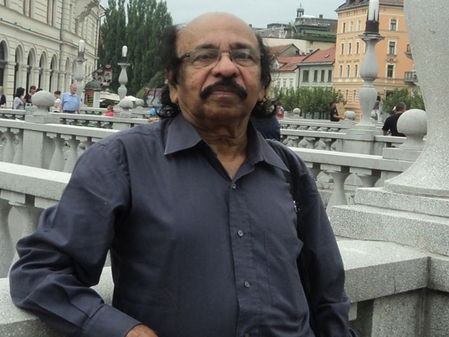
Thiruvananthapuram, Feb 9 (IANS) Poet and Kerala Sahitya Akademi Chairman K. Satchidanandan has reignited debate in Kerala’s political circles by reiterating his view that continuous rule is unhealthy for democracy, arguing that the state is better served when political fronts alternate in power.
Drawing on the experience of West Bengal, he warned that prolonged governance by any party risks weakening democratic institutions and eroding ideological foundations.
Satchidanandan said that after two consecutive terms in office, it is healthier for a party to sit in the Opposition, irrespective of whether it is the Left or the Congress.
“If the Congress was in power, I would say the same,” he remarked.
Continuous rule, he cautioned, often leads to corruption, centralisation of authority and the influx of opportunists, ultimately diluting a party’s core values.
He emphasised that the Opposition is central to the functioning of democracy, noting that remaining out of power can help parties rebuild strength and deepen their roots among the people.
According to him, electoral victory or defeat should not be the ultimate objective of political parties.
Instead, democracy must ensure that the voices of workers, farmers, Adivasis, minorities and other marginalised groups are heard.
In a diverse country like India, he argued, change can only be achieved by strengthening democratic processes rather than through revolutionary upheaval.
Referring again to West Bengal, Satchidanandan said Kerala’s Communist movement had not yet reached a similar stage of decline, but warned that another consecutive term could push it in that direction.
While acknowledging the Left government’s achievements in development and literacy, he expressed concern over what he described as a growing fear among citizens to criticise the ruling party, calling it a worrying sign for a democratic society.
He also criticised political compromises aimed at appeasing dominant community organisations and cautioned against prioritising majority sentiment over principled politics.
Communists, he said, have a responsibility to stand with non-communal minorities, particularly at a time when minorities feel increasingly vulnerable.
Such compromises, he argued, weaken parties ideologically and politically.
The remarks triggered strong political reactions. Former Health Minister and CPI(M) MLA K.K. Shailaja rejected Satchidanandan’s view, stating that the prevailing sentiment within the Left Democratic Front and among the public was that development should continue through stable governance.
CPI(M) state secretary M.V. Govindan, however, struck a more conciliatory note, saying the party would seriously consider criticisms, including those raised by Satchidanandan, and address any shortcomings associated with prolonged rule.
Leader of the Opposition V.D. Satheesan said the comments vindicated the Opposition’s stand, describing them as an acknowledgment of the political and organisational decline within the CPI(M).
Meanwhile, joining the issue was another hugely popular, award-winning novelist and writer, Sarah Joseph, who echoed Satchidanandan’s statement.
–IANS
sg/pgh