
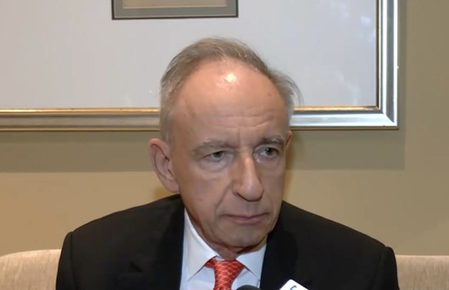
New Delhi, Feb 6 (IANS) Poland’s Deputy Foreign Minister Władysław Bartoszewski on Friday took note of India’s stellar economic growth, rising global stature and also shared insights on European nation’s inclination to deepen ties with India across multiple sectors, two of which remain high on its agenda – defence co-operation and green technology.
In an interview with IANS, Bartoszewski spoke about India–Poland relations, trade and investment opportunities, global geopolitical challenges, and the leadership of Prime Minister Narendra Modi. He emphasised that bilateral ties are on an upward trajectory and highlighted India’s rapid economic transformation, technological advances, and strategic importance on the world stage.
Here is the full interview:
IANS: How do you see the current trajectory of India–Poland relations?
Władysław Bartoszewski: Relations between India and Poland are on an upward trajectory. We signed a strategic partnership agreement with Prime Minister Narendra Modi in 2024, when he visited Poland for the first time as Prime Minister of India in 45 years. It was a very good visit. We have now also signed the Free Trade Agreement with the European Union, of which we are a part. I have just returned from the Foreign Ministry, where we discussed a number of practical steps dealing with military cooperation, digital industry cooperation, security issues, IT investments in high technology, cooperation in space, and other areas.
We are planning a visit by our Deputy Minister for Digital Affairs next month. I will return here in March, and our Deputy Minister for Development and Technology will also visit in March. We are planning a visit by our Prime Minister to Delhi later this year. We are also discussing visits by various officials, including Dr S. Jaishankar, to Poland later this year.
So I would say we are talking about business, politics, security, and a wide range of cooperation. The sky is the limit. Not so long ago, two astronauts went into orbit, one Indian and one Polish, and that is a symbol of our cooperation in the near future.
IANS: What are Poland’s plans and priorities for trade and investment engagement with India?
Władysław Bartoszewski: We have a number of sectors we are interested in. Definitely the ICT (Information and Communication Technology) sector—about 9 per cent of India’s GDP comes from this sector, while 7 per cent of our GDP comes from it, so it is a natural match.
We are quite advanced in digital technologies that serve the population. We have the ability to conduct most official business with government and regional bodies via telephone or computer, and we are trying to expand e-government. India is also quite advanced in this area.
We are discussing advances in military technology, including very high-tech solutions, with several Indian companies involved. We are also talking about production, possibly joint production in Poland and joint production in India under the Make in India principle.
We are involved in talks over green technologies, which are also of interest to India. We are quite advanced in water treatment. As far as I remember, there is a Polish company dealing with sewage in Mumbai.
We are rapidly transforming our energy sector from coal to renewable sources, including nuclear. We have started building a nuclear power plant and are also looking at small modular reactor plants. We are investing heavily in offshore wind farms and are also using biogas.
We have a very strong agricultural sector, which accounts for about 50 per cent of the value of our exports. Agricultural by-products can be used for biogas, which is a stable, renewable energy source. We are also interested in the Indian experience in green hydrogen and energy storage.
We are planning to engage with India on coal mining as well, as we have extensive experience, with most of our coal mines being open-cast.
IANS: What is your assessment of the recent India–US trade deal?
Władysław Bartoszewski: It is better to have a trade deal than not to have one. Generally speaking, tariffs do not bring prosperity to nations because they are ultimately paid by consumers when importers transfer the cost. The lower the tariffs, the better.
I think it is good that India and the United States reached an agreement that reduced tariffs significantly from the levels originally suggested.
IANS: Do you believe India secured a more favourable trade deal with the United States as compared to other countries? If so, why?
Władysław Bartoszewski: India is a very serious economic power. You are now number four in terms of GDP globally, and Prime Minister Narendra Modi has made it clear that India aims to become number three very soon. It is a huge market of nearly one and a half billion people. It is technologically advanced and changing rapidly. It does not make sense to ignore a country with such potential.
India is also a democratic state that recently conducted the largest democratic election in the world. It is a very good partner. It makes more sense to trade and have good relations than to have bad relations and not trade.
IANS: India has urged Poland to play a role in addressing terrorism in the neighbourhood. How do you respond?
Władysław Bartoszewski: We are already dealing with state-sponsored terrorism near our borders. We experienced two terrorist attacks on our trains. Thankfully, no one was killed, but it came very close, and it could have become an international scandal.
IANS: How do you assess India’s role and potential contribution toward ending the war in Ukraine?
Władysław Bartoszewski: India is not engaged in the war in Ukraine and is not involved in negotiations to end it. The war cannot be ended by India or Poland. It can be ended tomorrow by President Putin if he withdraws the forces of his colonial, neo-colonial, imperialistic army, trying to subjugate the free state of Ukraine once again.
Russia ruled Ukraine as a colony in the 18th and 19th centuries and now wants to do so again. Poland is opposed to all forms of colonialism and neo-imperialism.
IANS: What are your views on the leadership of Prime Minister Narendra Modi and his global impact?
Władysław Bartoszewski: Well, I think the Prime Minister is a phenomenal leader. He is very charismatic, as proven by being elected and re-elected several times. He has changed India dramatically and has a very ambitious vision for the country.
We are all very impressed by his actions and achievements. Privately, I can say that he is an absolutely charming, charismatic, and pleasant person. I believe many Indians feel the same way, because they follow his guidance and directions, which have moved India from the time when I was young—India was a poor country, and people did not have enough food. Europeans used to send food aid to India. Today, India is the fourth-largest economy and is moving very fast in the right direction under the leadership of Prime Minister Narendra Modi. So, I think you are lucky to have such a Prime Minister.
IANS: How do you assess the current situation in West Asia, particularly concerns about escalation between Iran and the United States?
Władysław Bartoszewski: I believe a full-scale conflict will be avoided. There is a possibility of an agreement between the United States and Iran because Iran is now in a much weaker position.
Iran cannot effectively use its proxies, such as Hamas or Hezbollah, which are in disarray, and to some extent, the Houthis. There are also massive protests within Iran against the system and the rule of the Ayatollahs.
I believe a peaceful agreement is possible, and I do not foresee a major war breaking out in the region at this time.
IANS: How do you view China’s role in the Ukraine conflict and tensions involving Iran?
Władysław Bartoszewski: I look at China’s role in the war in Ukraine negatively, and we communicate this to our Chinese partners whenever we talk to them. According to the estimates, over 80 per cent, or close to 90 per cent, of all dual-use components used in Russian weapon systems are transferred to Russia by China, and that is something which fuels the war.
China is also a major buyer of Russian oil and gas, which provides a source of income for Russia and helps them continue fighting the war. We mention this to the Chinese every time we talk to them.
The Chinese claim that they do not supply any dual-use materials. We have to disagree with them on this.
IANS: How do you see NATO’s evolving role, and what implications does it have for countries outside the alliance, such as India?
Władysław Bartoszewski: NATO was formed in 1949 as a defensive alliance to protect the countries of Western Europe from a potential Soviet invasion. Eastern European countries later joined NATO for the same reason, to protect themselves against the aggressive Russian Federation.
Russia claims that all areas of Eastern Europe should be under its control. We reject that. We are sovereign states, members of the United Nations, and like India, we believe that international law, not military force, should resolve disputes.
NATO has no intention of attacking anyone. Finland and Sweden, which were previously non-aligned and neutral for over 200 years, joined NATO because they felt threatened by Russia’s policies.
NATO member states maintain very good relations with India, including the United States, France, Germany, and Poland. We recognise India’s global role. I mentioned in a previous interview in New Delhi that Prime Minister Modi spoke to President Putin, discouraging him from using a tactical nuclear weapon in Ukraine in late 2022. President Xi Jinping also played a similar role. This demonstrates positive contribution India makes in world affairs, and I expect that role to continue.
–IANS
rs/mr