
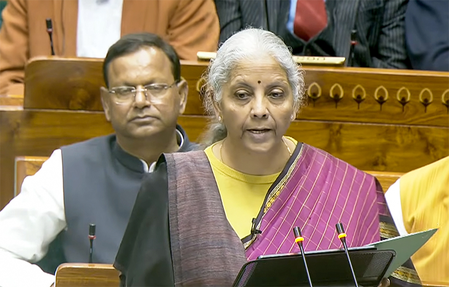
New Delhi, Feb 1 (IANS) Presenting the Budget for 2026-27 on Sunday, Union Finance Minister Nirmala Sitharaman proposed a dedicated freight corridor connecting Surat in Gujarat and Dankuni in West Bengal.
The new freight corridor will establish a direct link between the two states, setting up new corridors for logistics and freight movement.
The Finance Minister also proposed to operationalise 20 new national waterways over the next five years, to promote an environmentally sustainable route for cargo movement.
The dedicated freight corridor between Gujarat and Bengal assumes significance as the Eastern state is slated to go to polls later this year. The corridor will traverse through multiple states across the Eastern and Western regions and connect the wealthier and industrial zones of Gujarat with Bengal, a relatively inferior and laggard state on various indexes of growth.
The proposed project seeks to project the Centre’s focus on bringing big projects to Bengal and creating a congenial environment for fast-paced growth.
Besides this, the Finance Minister also announced “rare earth corridors” in four states.
She announced that dedicated corridors will be set up for minerals in four states — Tamil Nadu, Kerala, Odisha and Andhra Pradesh.
Two of these states are headed for Assembly elections this year.
“The scheme for rare earth permanent magnets was launched in November 2025. We now propose to support the mineral-rich states of Odisha, Kerala, Andhra Pradesh and Tamil Nadu to establish dedicated rare earth corridors to promote mining, processing, research and manufacturing,” said FM Sitharaman in her ninth Budget speech on Sunday.
Notably, rare earths are a group of elements widely used in building equipment of strategic importance and fighter jets.
Rare earths have lately emerged as ‘key assets’ in the geopolitical landscape, and nations are vying to have a large share.
Currently, China has a near-monopoly on rare earths, controlling 60 per cent of the world’s mining and more than 90 per cent of processing capacity.
This announcement is a step towards building the country’s own domestic capacity, thereby reducing dependence on foreign nations, including China.
–IANS
mr/svn