

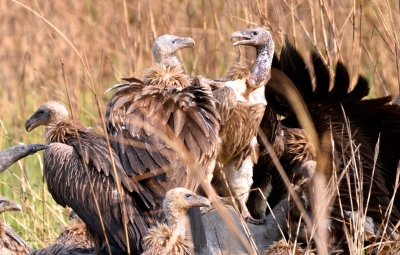
New Delhi, March 19 (IANS) Six critically endangered white‑rumped vultures were released as a pilot by the Assam State Forest Department at the Vulture Reintroduction Aviary in Rani Range, near Kamrup district, on Thursday. All the birds have been tagged with GPS/satellite transmitters for intensive monitoring.
Four more wild vultures successfully rehabilitated by the BNHS vulture team have also been fitted with transmitters and released along with the captive‑bred birds, bringing the total number of released vultures to 10.
The release marks an important step towards the recovery of vulture populations, which have been decimated across Asia due to toxic veterinary drugs.
A recent publication showed that Assam has low levels of toxic veterinary drugs, although the availability of nimesulide had been increasing. However, nimesulide, along with aceclofenac and ketoprofen, has recently been banned by the Indian government. It is hoped that the environment will be fully safe once these bans take full effect.
It is well established that toxic veterinary painkillers used in cattle can rapidly wipe out vulture populations. The Assam Forest Department project, managed by BNHS, has been collecting cattle carcass samples to confirm that no toxic drugs remain in use.
Studies have shown that fewer than one per cent of cattle carcasses containing lethal levels of diclofenac were enough to cause the catastrophic vulture declines seen in India from the mid‑1990s to early 2000s.
A target of 800 samples has been set to statistically confirm the absence of diclofenac in vulture food. So far, 150 samples have been analysed and found to be free of toxic NSAIDs, with 650 more to be collected within a 100‑km radius of the release site.
The six captive‑bred vultures released had all fledged from the nearby Rani Vulture Conservation Breeding Centre, managed by BNHS with support from the Royal Society for the Protection of Birds (RSPB) and the Assam Forest Department.
BNHS centre manager Dr Sachin Ranade said the team would constantly monitor the birds’ movements and intervene if needed.
Chief Wildlife Warden Vinay Gupta said Assam had made important progress in removing dangerous veterinary drugs and was closer to ensuring a safe environment for vultures.
SAVE Chair Jemima Parry‑Jones said that with reduced veterinary use of toxic painkillers and strong support from RSPB, the region was moving closer to declaring a true “Vulture Safe Zone”.
BNHS Director Kishor Rithe said more awareness was needed among veterinarians and farmers about safe alternatives such as meloxicam and tolfenamic acid, but significant progress had been made.
Elated over the release, Chris Bowden, representing the RSPB, said it had been a long journey to address drug‑related threats and accidental poisoning, and that maintaining captive populations had been vital for future releases.
–IANS
vg/dan