
Seoul, Dec 2 (Yonhap) South Korea and the United States have agreed to swiftly launch working groups for follow-up negotiations on the recent summit agreements, including Seoul’s plans to build nuclear-powered submarines and pursue civil uranium enrichment rights, the foreign ministry said on Tuesday.
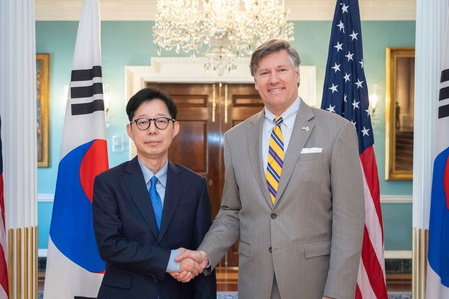
First Vice Foreign Minister Park Yoon-joo shared the need with U.S. Deputy Secretary of State Christopher Landau during their talks in Washington on Monday (local time), the first high-level follow-up dialogue since the release of the joint fact sheet on Nov. 14.
“The vice minister and the deputy secretary agreed on the need to swiftly initiate sectoral working groups to ensure the swift and thorough implementation of follow-up measures in key areas, such as nuclear energy, shipbuilding and nuclear-powered submarines,” the ministry said in a release, reports Yonhap news agency.
“Vice Minister Park requested a swift initiation of talks between Seoul and Washington on the civil uranium enrichment and spent fuel reprocessing capabilities,” it said.
Landau, in turn, said the two countries “should continue to communicate closely on the matter,” according to the ministry readout.
The joint fact sheet lays out the commitments on trade, investment, security and other issues made during the two recent summits between President Lee Jae Myung and U.S. President Donald Trump in August and October.
In the document, the U.S. states support for the process that will lead to South Korea’s civil uranium enrichment and spent fuel reprocessing for peaceful use, consistent with their existing bilateral nuclear energy pact and subject to U.S. legal requirements.
The U.S. has also given approval for South Korea to build nuclear-powered attack submarines and committed to advancing requirements to enable these efforts, including avenues to source fuel.
Under the bilateral 123 Agreement, South Korea may enrich uranium for civil purposes or reprocess spent fuel only with U.S. consent, following bilateral consultations in accordance with treaties and other regulations governing both countries. The agreement is seen as effectively barring Seoul from carrying out these activities.
Attention has been focused on how the allies will move forward with implementing the fact sheet agreements, especially concerning uranium enrichment and spent fuel reprocessing capabilities.
The two sides also agreed to work together so that the follow-up talks on the nuclear-powered submarines and shipbuilding cooperation could proceed in earnest, the ministry said.
Park also explained to his counterpart Seoul’s efforts to implement its fact sheet commitments and asked the U.S. to take corresponding measures, including lowering the U.S. tariffs on South Korean goods.
Regarding the U.S. visa system for South Korean investors, Park noted substantive progress with the launch of a dedicated visa desk for Korean businesses, and asked Landau to continue paying attention to ensure their smooth entry into the U.S.
Speaking to reporters shortly after the talks, Park indicated that each side will designate officials responsible for the follow-up fact sheet negotiations between the relevant government agencies.
“The U.S. will assign its representatives, and we will create our own task force to coordinate with them,” he said.
While in Washington, Park also plans to meet with officials from the State Department handling Korea affairs and the White House National Security Council to discuss follow-up steps after the summits and issues related to North Korea, the ministry said.
In a separate readout, the U.S. State Department said that the two sides discussed the implementation of the joint fact sheet, including the commitments to modernize the alliance and shipbuilding cooperation.
“They discussed the implementation of the U.S.-ROK Joint Fact Sheet, which includes modernising the U.S.-ROK Alliance — the linchpin of peace, security, and prosperity on the Korean Peninsula and throughout the Indo-Pacific region for more than 70 years,” said Tommy Pigott, principal deputy spokesperson.
—IANS
na/