
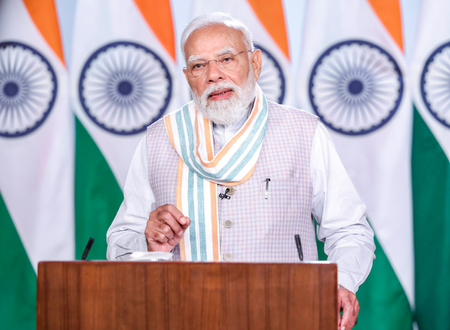
New Delhi, May 24 (IANS) Prime Minister Narendra Modi on Sunday shared an article authored by Union Minister Jyotiraditya M. Scindia as Sikkim enters its 51st year of statehood.
The Prime Minister noted that the article highlights Khangchendzonga, lauding it as the protector of the land, memory, and consciousness of Sikkim.
“He highlights that the five treasures of Khangchendzonga continue to illuminate the state’s journey, paving the way for Viksit Sikkim 2047,” PM Modi wrote on X.
The minister writes that Khangchendzonga, the “mountain massif”, stands out in our imagination as distant Himalayan peaks wrapped in Lungta prayer flags, clouds and snow. Nearly one-fourth of Sikkim’s land is embraced by the Khangchendzonga National Park. For centuries, Khangchendzonga has lived in the folklore of the indigenous communities as a sacred civilisational force — the protector of land, memory and consciousness of Sikkim itself. The great Lama Lhatsun Chenpo interpreted this belief with poetic brilliance, calling the five summits as the Five Treasures of the Eternal Snow, “the peak most conspicuously gilded by the rising sun is the treasury of gold, the peak that remains in cold grey shade is the storehouse for silver, and other peaks are vaults for gems, grains and the holy books.”
The minister states that during his recent visit for Sikkim’s 51st Statehood Day celebrations, this lore revealed itself with renewed contemporary relevance.
The first treasure is gold, and nowhere is Sikkim richer than in its people. Development acquires permanence only when it grows from the confidence of communities, and Sikkim offers compelling evidence of that truth in the unity and social harmony of the Lepcha, Bhutia and Nepali communities, Scindia observed.
He underscored that the second treasure, silver, manifests itself through Sikkim’s elemental beauty and biodiversity. The Teesta and Rangeet rivers revealed themselves between the dense forests and clouds, while unbloomed cherry trees stood amongst the slopes of tea gardens, awaiting the onset of winter.
The third treasure is gems, and in Sikkim, these gems are cultural, spiritual and civilisational. They appear in various monasteries, in the grand Buddha Park at Ravangla, in the Bhaleydhunga skywalk overlooking the valley and in the sacred geography blessed by Guru Padmasambhava himself. Sikkim continues to preserve a sense of spirituality that feels increasingly precious and pristine in today’s restless world. This spiritual inheritance now coexists with modern aspirations, the minister states.
He also highlights that the fourth treasure, grains, carries the story of sustenance. Sikkim’s journey as a 100 per cent organic state is among the most important developmental achievements in contemporary India. The state’s success in organic farming, cardamom cultivation and sustainable agriculture demonstrates how mountain ecosystems can sustain prosperous local economies.
The fifth treasure, the holy books, is Sikkim’s intelligence. It lives in education, where the new educational institutions and the permanent campus of Sikkim State University in Namchi reflect a future that respects tradition while opening doors to knowledge, skill and innovation. The future of Viksit Bharat shall depend substantially upon how effectively such institutions nurture talent across the frontier regions of the country. PM Modi’s visit made this clear, as he spoke of education, connectivity, health care, urban development and tourism as the pillars of Sikkim’s next phase. The old and the new meet here with unusual grace, and the result is a development model rooted in heritage, the minister added.
–IANS
sps/uk