
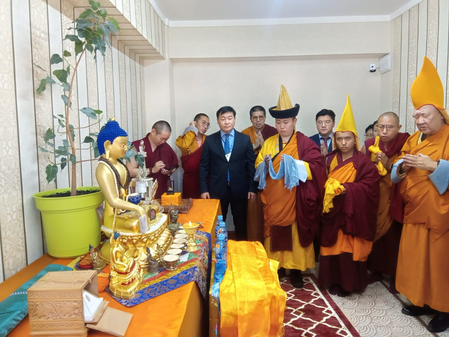
Ulaanbaatar/New Delhi, May 27 (IANS) An exposition of the Holy Relics of the chief disciples of the Buddha — Arahant Sariputta and Arahant Mahamoggallana — will be organised at the Ganden Monastery in Mongolia’s Ulaanbaatar from June 1-10 by India’s Ministry of Culture, the International Buddhist Confederation (IBC) and New Delhi’s National Museum.
In June 2022, four sacred Kapilavastu Relics of the Buddha were taken from the National Museum of India to Mongolia for an 11-day exposition, marking their first visit to the country in 29 years. The exposition began on June 14, 2022 on the occasion of Mongolian Buddha Purnima. The Relics were displayed alongside Mongolia’s revered Buddha Tooth Relic at the Gandantegchinlen Monastery in capital Ulaanbaatar. The Relics were taken on board a C-17 transport aircraft of the Indian Air Force (IAF) and accompanied by the then Minister of Law and Justice, Kiren Rijiju, and the 20th Kushok Bakula Rinpoche.
In October 2025, during the four-day State Visit of Mongolian President Khurelsukh Ukhnaa to India, Prime Minister Narendra Modi announced the significant Holy Relics Exposition of Arahant Sariputta and Arahant Mahamoggallana in Mongolia, scheduled for 2026. Prime Minister Modi had underscored the shared Buddhist heritage of the two nations and the deep connection to the ancient teachings of Buddhism. The Relics’ journey, asserted PM Modi, is not just a religious occasion but also a celebration of mutual respect for Buddhism’s profound influence across borders.
While addressing a joint press meet with Mongolian President Khurelsukh Ukhnaa following their talks at the Hyderabad House in New Delhi on October 14, PM Modi said: “The relationship between India and Mongolia is not merely diplomatic — it is a bond of warmth and spirituality. The true depth and breadth of our relationship is reflected in our people-to-people ties. For centuries, both countries have been bound by the thread of Buddhism, which has led to us being called spiritual siblings. Today, to further strengthen this tradition and give new strength to our historical ties, we have taken several important decisions.
“I am pleased to announce that next year, the holy relics of two great disciples of Lord Buddha – Sariputra and Maudgalyayana – will be sent from India to Mongolia. We will also send a Sanskrit teacher to Gandan Monastery to study the Buddhist texts there in depth and carry forward the ancient tradition of knowledge,” he had stated then.
Arahant Sariputta and Arahant Mahamoggallana were the two chief disciples of the Buddha. Among the countless disciples of the Buddha, none showed greater wisdom and spiritual mastery than Arahant Sariputta and Arahant Mahamoggallana. Arahant Sariputta and Arahant Mahamoggallana were born on the same day in adjacent villages in the Magadha region, near present day Nalanda. Arahant Sariputta was born in Upatissa village and Arahant Mahamoggallana in Kolita village. Arahant Sariputta is celebrated throughout the Buddhist world as the supreme exemplar of wisdom, analytical insight and doctrinal mastery.
The relevance of the journey of the Relics of Arahant Sariputta and Arahant Mahamoggallana to Mongolia lies in their role as Dhamma carriers, pillars of the early Sangha whose lives exemplified the transmission and safeguarding of the Buddha’s teachings.
“The Relics of these two chief disciples symbolise the preservation, interpretation and transmission of that Enlightenment into the world. Together, they personify the two inseparable dimensions of Buddha Dhamma: wisdom and realisation; doctrine and direct experience. Their Relics, therefore, symbolise the living principles through which liberation becomes possible. In Buddhist traditions, the Sangha, especially the noble Sangha, is regarded as one of the Three Jewels alongside the Buddha and the Dhamma. The Relics of Arahant Sariputta and Arahant Mahamoggallana thus represent the realised Sangha in its purest form,” read a statement issued by the IBC.
“For Mongolia, the arrival of these Relics will have great meaning. Mongolia’s Buddhist identity has historically been rooted in devotion, scholarship, monastic discipline and meditative tradition. The exposition will establish a sacred and tangible connection because they complete the living picture of the Buddha Dhamma,” it added.
In 1978, the then External Affairs Minister (EAM) and later Prime Minister of India, Atal Bihari Vajpayee had stated: “India and Mongolia are ancient lands of the ancient people of Asia. The historic and cultural collaboration between India and Mongolia is most fascinating and unique and is as old as the history of the spread of Indian culture and ideas into Central Asia and Siberia. We in India consider the Mongol veneration of Sanskrit a matter of special privilege. We hold the people of Mongolia in high esteem for preserving in translation as well as in manuscripts, the vast collection of our precious Sanskrit text on our philosophy, poetry, logic and astronomy lost by us over centuries. In modern times, too, many Mongols visited India–the land of Buddhism.”
A powerful contemporary example of the equal reverence accorded to the sacred Relics of Arahant Sariputta and Arahant Mahamoggallana alongside the Relics of Gautama Buddha can be seen in the historic enshrinement ceremony in Bangkok, more than two years ago. In February 2024, Somdet Phra Sangharaja Sakon Maha Sanghaparinayok and Srettha Thavisin jointly presided over a grand state ceremony at Sanam Luang for the enshrinement of the sacred Relics of the Lord Buddha together with the Relics of the two chief disciples, Arahant Sariputta and Arahant Mahamoggallana. The ceremony was organised by the Royal Thai Government in cooperation with the Government of India under the ‘Ganga–Mekong Holy Buddha Relics’ initiative, as part of the celebrations commemorating the 72nd birthday, or sixth-cycle anniversary, of Thailand’s King.
–IANS
/as